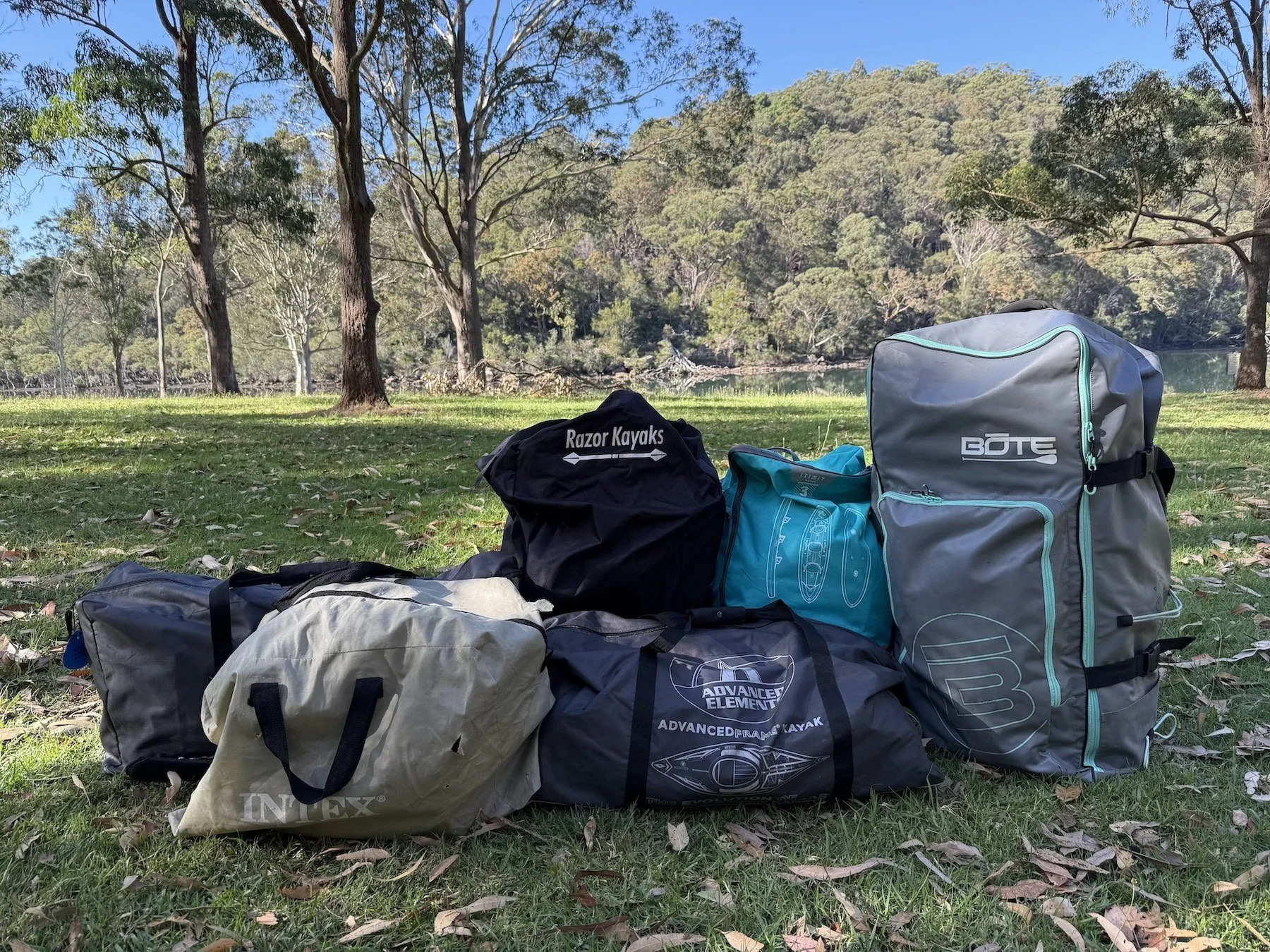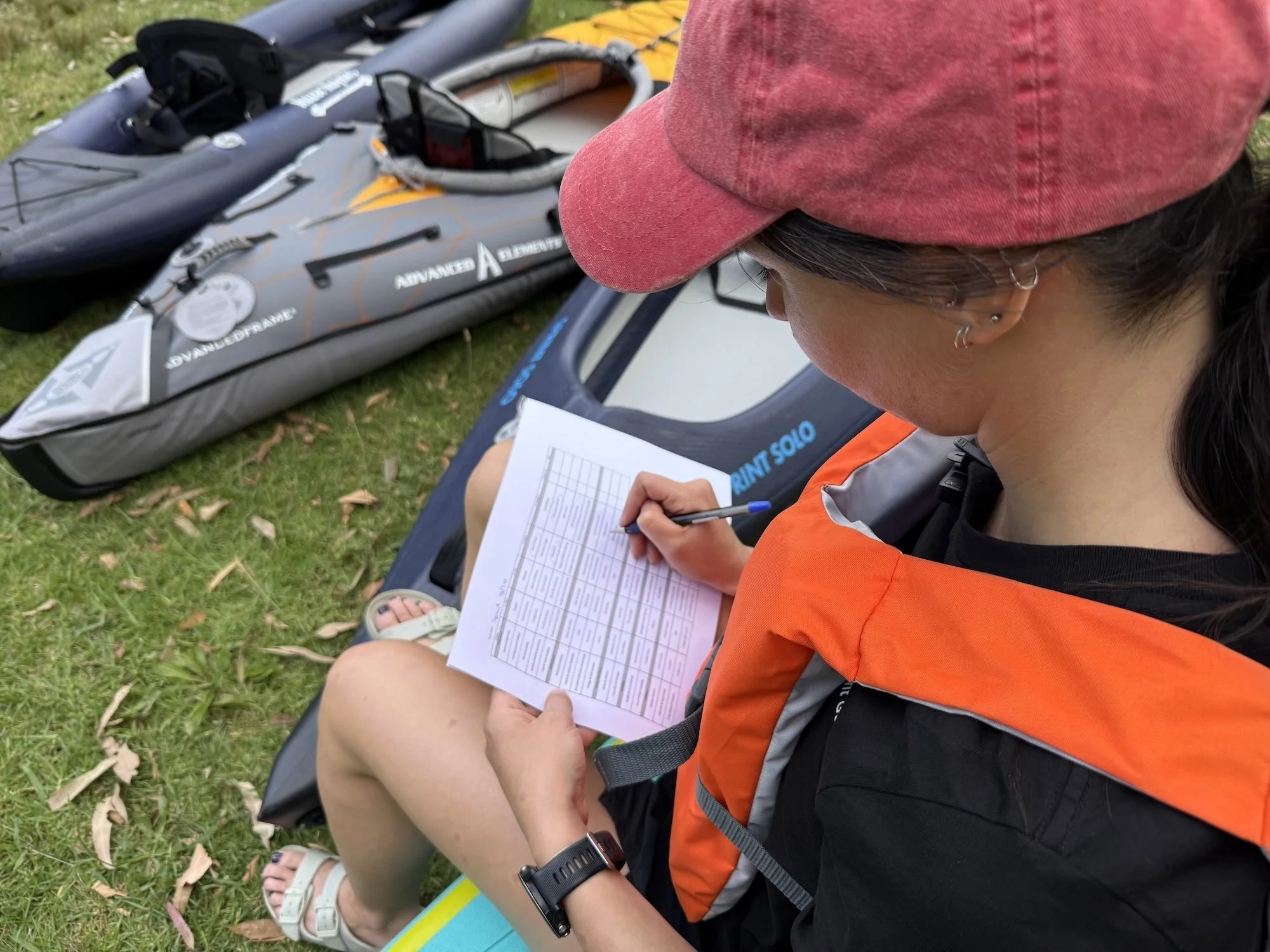
Everything You Need to Know About Inflatable Kayaks in the US
This guide is part of our explainer series, where we take a closer look at specific gear. In this case, we're diving into inflatable kayaks.
We've put this together to be a solid go-to resource for anyone wanting to get a better handle on inflatable kayaks, whether you're brand new to paddling and thinking about picking up your first kayak, or you've got some time on the water and want to compare what's out there.
Here, we're zeroing in on inflatable kayaks for US conditions. That means you'll find insights from our own testing on how different materials hold up across a wide range of environments, whether it be cold Pacific Northwest waters to warm Gulf Coast paddling, sun exposure, saltwater, and the everyday realities of hauling and storing a kayak in various climates across the country.
We're aiming to give you an in-depth, evidence-based look at every aspect of inflatable kayaks, such as their background, types, construction materials, safety, test results, and where relevant, regulations that apply across different states.
Click the links to the right to head there now.
An inflatable kayak is a lightweight watercraft made up of several air chambers, usually between two and eight, that keep it buoyant and give it its shape. While early or cheaper models tended to feel more like pool toys than proper kayaks, the introduction of drop-stitch technology (which makes the hulls far more rigid) has completely changed the game. These days, a good inflatable can hold its own against many traditional hard-shell kayaks.
For US paddlers, inflatables come with a few clear advantages:
They're great for anyone short on space, easy to store in an apartment, garage, or storage unit.
You can carry and set one up without having to wrestle a heavy kayak onto a roof rack.
They're perfect for road trips, whether you're driving to the Boundary Waters, heading to the Florida Keys, or exploring mountain lakes out West.
They pack down neatly for camping trips, van life adventures, or weekend getaways.
Depending on the model, inflatable kayaks work brilliantly on calm lakes, slow-moving rivers, and sheltered coastal waters. Some are even designed to tackle whitewater, so there's plenty of scope no matter how you like to paddle.
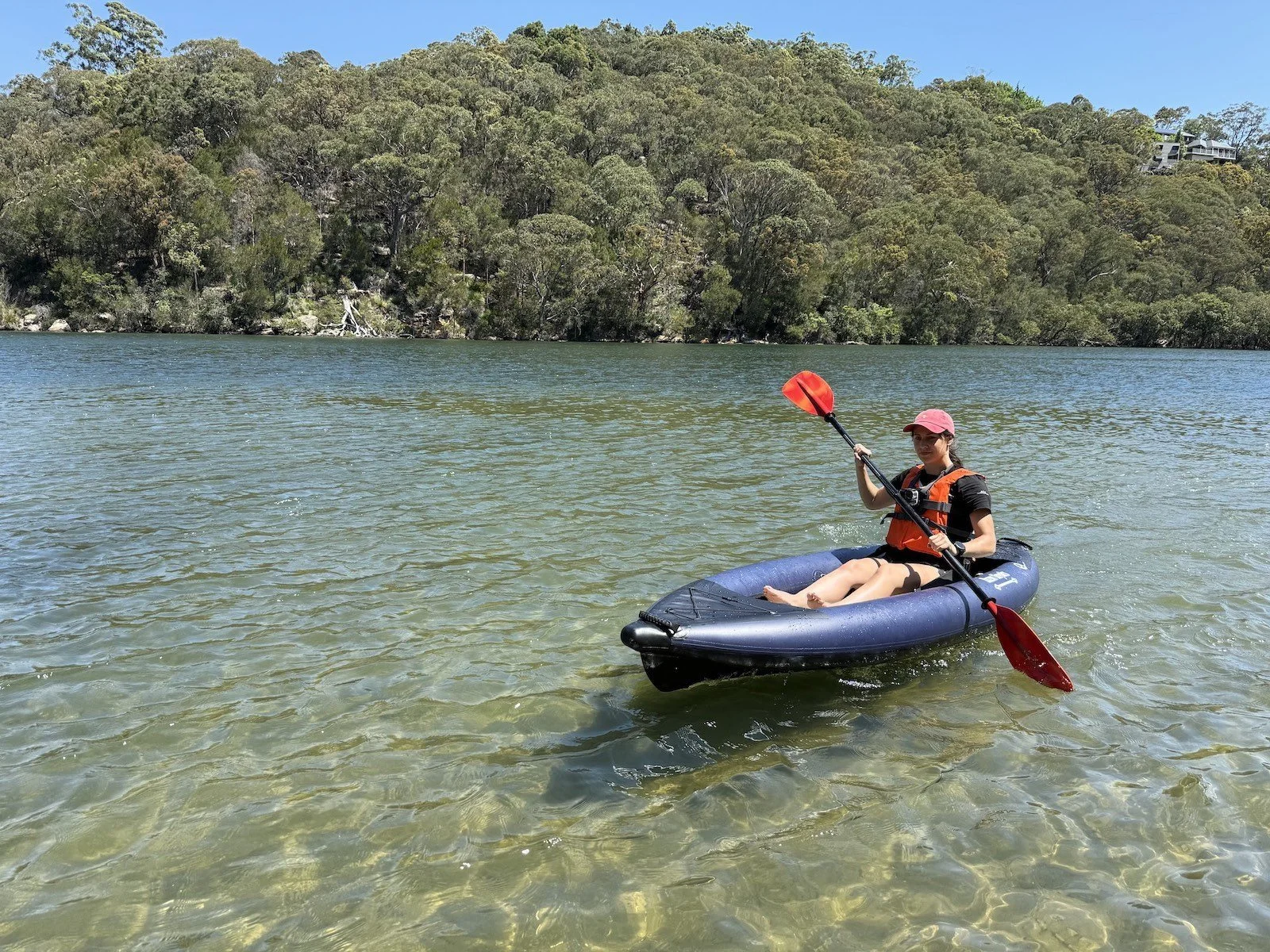
So how do inflatable kayaks differ from hard-shell kayaks, packrafts, or stand-up paddleboards (SUPs)? The most obvious difference from hard shells is that inflatables can be deflated and packed down much smaller, making them far easier to store and transport. This is a big win for us US paddlers who live in apartments, rely on smaller vehicles, or want to fly to a destination and rent or bring our own boat. Inflatable kayaks also tend to be easier and cheaper to repair than hard-shell models.
Packrafts, on the other hand, are usually much lighter and pack down smaller than inflatable kayaks. They're built for maximum portability rather than long-distance paddling in a straight line, so they're not as efficient or stable for covering distance on open water.
SUPs are typically made from a drop-stitch floor with no side tubes and are designed for standing rather than sitting. You can also find SUP-kayak hybrids, which generally work well as SUPs but can feel a bit more cumbersome to paddle when used as kayaks because of their wide, flat shape.
Inflatable kayaks are a great fit for anyone after a portable craft for recreational outings or day trips, and some are even suited to multi-day adventures. There are models built for all kinds of paddling, from relaxed flatwater and touring to rivers, choppy bays, coastal stretches, and even whitewater. You can read more in our Types of Inflatable Kayaks section.
| Feature | Inflatable Kayaks | Hard Shell Kayaks | Packrafts | SUPs/SUP-kayak hybrids |
|---|---|---|---|---|
| Portability | Pack down to fit into the boot of a small car, large backpack size | Don't pack down (unless modular) - need to be transported on roof racks | Extremely lightweight and pack down into a small backpack for hiking, cycling and other remote journeys | Similar to inflatable kayaks but usually slightly larger |
| Paddling performance | The best models prioritise paddling efficiency, straight-line tracking and manoeuvrability for covering longer distances and enjoying recreational paddling. Some models handle whitewater and coastal chop | Recreational hard-shells prioritise paddling efficiency, stability and manoeuvrability, performance hard shells are built for excellent straight-line tracking | Allow you to access remote waterways and some models can handle whitewater, however there are generally trade-offs in straight-line tracking and they're a lot harder to cover longer distances in | Extremely stable but difficult to turn and harder to push forward through the water. Specifically for those who want to be able to choose between standing and sitting to paddle |
Kayaking has roots in several ancient cultures, where it was first developed as a way to gather food and explore waterways. Early kayaks were built from whatever natural materials were available, such as wooden frames, animal skins, bark, hollowed-out trees, or woven cane, depending on the environment.
The idea of inflatable boats has been around for centuries too. Ancient troops in Assyria, Persia, and Central America are known to have used inflated animal skins to cross rivers. In the 1840s, Lieutenant Peter Halkett designed a portable craft made from rubber-coated cloth that could be worn as a cloak or carried in a bag, then inflated into a small boat for river crossings.
The first commercial inflatable boats appeared around the 1930s with the French company Zodiac, which had previously made airships. Around the same time, American inventor Waldo Semon developed plasticized PVC, a flexible and waterproof material that became crucial in shaping the first true inflatable kayaks.
A later breakthrough came with the invention of drop-stitch fabric, which made it possible to build flat, high-pressure inflatable panels. Originally developed for use in aviation, this technology gave inflatable kayaks a much stiffer and more stable hull, dramatically improving how they handled on the water.
In the US, interest in inflatable kayaks grew alongside a broader outdoor recreation boom. The German manufacturer Johannes Klepper had helped popularize folding boats, known as Faltboots, in the early 1900s, and these made their way across the Atlantic as paddling caught on. British explorer John MacGregor had already brought wider attention to portable, non-rigid boats as early as 1860. By the 1960s and 70s, inflatable kayaks were gaining real traction in America, helped along by growing interest in whitewater rafting and backcountry adventure. Their open, approachable design made them a natural fit for newcomers, especially compared with heavier, more specialized hard-shell kayaks.
As materials and build quality improved, inflatables evolved from basic rental boats into reliable, high-performance craft now used on lakes, rivers, and coastal waters right across the country.
Types of Inflatable Kayaks
Knowing the different types of inflatable kayaks makes it a lot easier to find the right fit for how you actually paddle. Think about where you'll be spending most of your time on the water, and use that as your starting point. Here's a quick rundown of the main types.
-
Shorter and wider, which makes them easy to handle
Built with stability in mind rather than raw speed
Often the most budget-friendly option, though there are plenty of quality recreational models at higher price points too
Versatile enough to handle a variety of water types
-
Longer, narrower hulls built for covering distance efficiently
Typically include drop-stitch floors and multiple air chambers or valves
Prioritize straight-line tracking, speed, and load capacity
Better off without self-bailing ports, since these create drag and slow you down on longer stretches
-
Wide, stable platforms with plenty of attachment points for rods, tackle, and gear
Reinforced hulls that can handle heavier loads and take a knock without complaint
More deck space and practical features built in
Often come with elevated seats for a better casting position
A drop-stitch floor is a must for solid stability when you're casting or fighting a fish
-
Self-bailing designs with floor drainage ports to shed water fast
Built from tough, abrasion-resistant materials that can take a beating
Shorter hulls for quick, responsive turning in tight spots
A bit wider for better stability when things get rowdy
-
Folding kayaks: Use collapsible frames or hinged panels instead of inflation. There's a bit of a learning curve when setting them up, and the fold points can wear over time. They perform well once assembled, but they'll sink if capsized, so they're not a great pick for surf or whitewater.
Modular (clip-together) kayaks: Made from rigid sections that lock together with clips and waterproof seals. Bulkier to transport than a true inflatable, but solid performers on the water. A good option if you're usually launching from a parking lot close to the water.
Hybrid inflatable-rigid kayaks: Mix inflatable sections with rigid frames or panels to get better overall stiffness than a pure inflatable.
SUP-kayak hybrids: Essentially paddleboards with a seat attachment thrown in. Fine for easy, mellow paddling, but don't expect them to perform like a dedicated kayak.
| Type | Typical Use | Stability | Speed | Portability | Who It's For |
|---|---|---|---|---|---|
| Recreational | Enjoyment, family use, leisurely exploration | Stable | Can be slower, but drop-stitch models are fast | Very portable | First-time or casual paddlers, those covering shorter, more relaxed distances, families and pet owners, those who value stability |
| Touring | Covering longer distances, day- or multi-day expeditions | Can be less stable | Faster | Still portable, but often heavier than recreational kayaks | More experienced paddlers or those who want to cover longer distances more efficiently, fitness paddlers, multi-day paddlers |
| Fishing | Fishing, leisurely paddles | Very stable | Slower | Still portable, but often heavier than recreational kayaks | Those who mainly want to use their kayak to fish from |
| Whitewater | Lower grade to more technical whitewater | Stable | Slower | Very portable | Beginner to expert whitewater kayakers |
| Folding | Depends on hull shape but generally recreational or touring (lower weight capacity than a touring inflatable) | Can be less stable | Depends on shape but smooth surface can be very fast on a longer hull | Very portable | Those who prefer not to use or purchase a pump |
| Modular | Recreation | Stable | Medium | Bulkier and heavier | Those looking for a hard-shell kayak that can fit in a car boot |
| SUP/kayak hybrid | Choice between standing to paddle or a leisurely kayak | Very stable | Slow | Depends on design, ranges from very portable to relatively bulky | Those primarily wanting a stand-up paddleboard, but with the option of being able to sit and paddle |
Hull shape plays a bigger role than most people realize. It affects how a kayak tracks, how stable it feels underfoot, and what kind of paddling it's actually suited to. Most inflatable kayaks fall into one of three main hull types, so here's what you need to know about each.
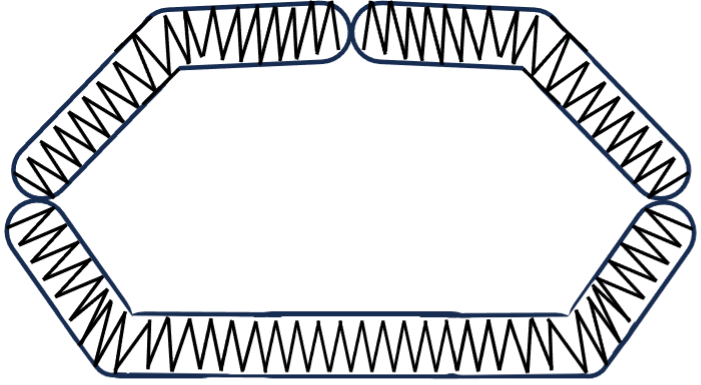
An i-beam hull uses a series of internal tubes or beams running lengthwise along the floor, from bow to stern. Their job is to hold the floor panels together and stop them from ballooning out when inflated. Modern drop-stitch construction does the same thing but in a more refined way. Larger side tubes run along each edge, adding buoyancy, structure, and lateral stability. These typically inflate to around 1 to 3 psi, which can leave the floor feeling a little soft when you're sitting in it.
Most i-beam hulls are made from vinyl or fabric-covered vinyl and show up most often in entry-level kayaks. A handful of European brands like Gumotex and Grabner use higher-grade materials to produce a firmer result. Advanced Elements also builds i-beam floors into many of their models, reinforcing them with internal aluminum ribs to help hold their shape.
One upside of i-beam kayaks is that they tend to be lighter than drop-stitch models, since drop-stitch fabrics are packed with internal threads that add weight. The tradeoff is that they can't hold as much air pressure, so they feel softer and don't track quite as cleanly through the water.
Perfect for: Beginners or anyone shopping at the more affordable end of the market.
I‑Beam Hulls

This hull pairs a firm, flat drop-stitch floor with traditional inflatable side tubes for buoyancy and balance. Some manufacturers add hard plastic caps at the bow and stern to sharpen up the shape and add a bit more rigidity. Materials are typically fabric-covered vinyl or high-grade PVC.
The combination gives you a stable, capable platform that handles a wide range of conditions reasonably well, which is why you'll see this setup used a lot in recreational and fishing kayaks. Because the side tubes are hollow rather than solid drop-stitch, they can also help keep the overall weight in check.
Perfect for: Casual paddlers heading out on lakes, mellow rivers, or anyone who wants a relaxed fishing platform.
Drop‑Stitch Floor with Side Tubes

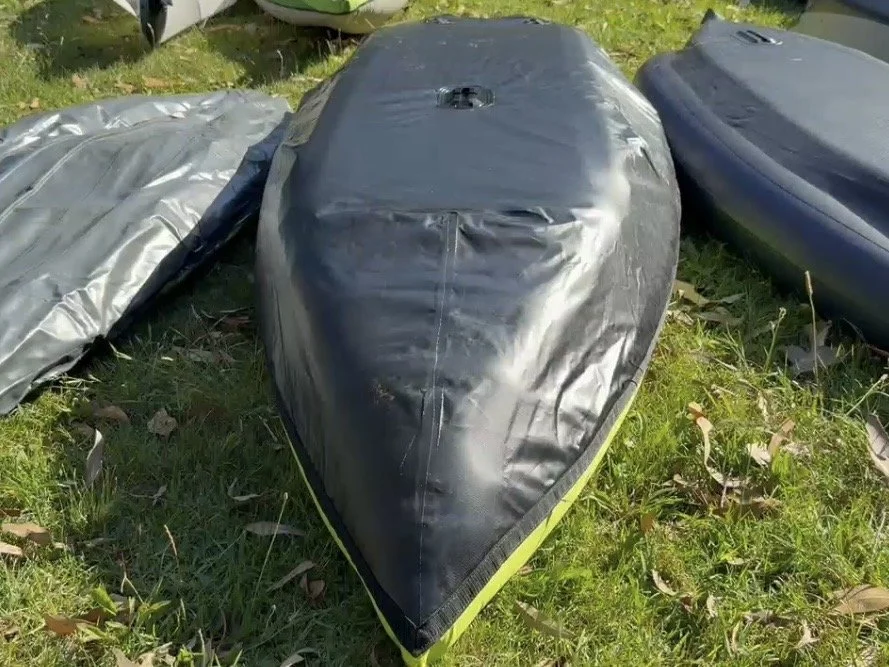
This design uses three flat drop-stitch panels joined together to form a shallow bathtub profile. These kayaks are typically built from tough PVC with a smooth, fast-drying outer skin and solid bow and stern caps. They inflate to higher pressures, usually somewhere between 8 and 10 psi, which gives them a noticeably stiff and responsive feel.
The shape tends to be longer and narrower than other inflatable hull types, which helps the kayak move efficiently and hold a straight line. How well a specific model performs comes down to details like hull width, the angle of the side walls, and how the bow and stern are shaped. The one thing to keep in mind is that stability can feel a little different here. Once the kayak tips off the flat center floor, it rolls toward the next flat panel, which takes some getting used to if you're coming from a wider recreational design.
Perfecr for: Touring paddlers and fitness paddlers who want to cover distance on the water.
‘Bathtub’ Shape Drop‑stitch Hulls

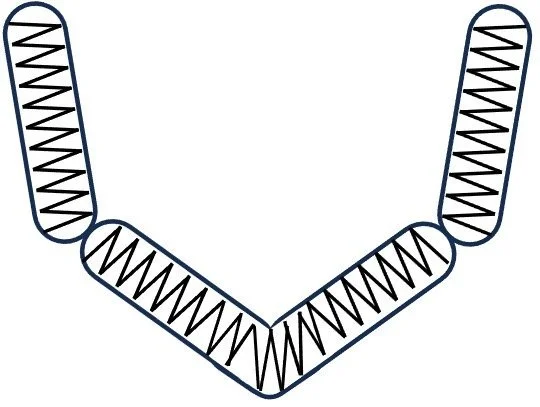
V-shaped hulls are built by connecting multiple drop-stitch panels, or by shaping sections so the bow and stern come to a point while the middle stays relatively flat. That pointed profile creates a natural keel effect, helping the kayak hold a straight line through the water, with the PVC outer skin keeping things smooth.
These kayaks can move pretty quickly, but the tradeoff is that they tend to feel less stable, particularly in longer and narrower configurations. There's also an inherent tension between tracking and turning with this hull shape. They're great at holding a line, but getting them to change direction takes a bit more work.
Perfect for: Paddlers who like putting in miles on flat, calm water.
V‑Shaped Hulls
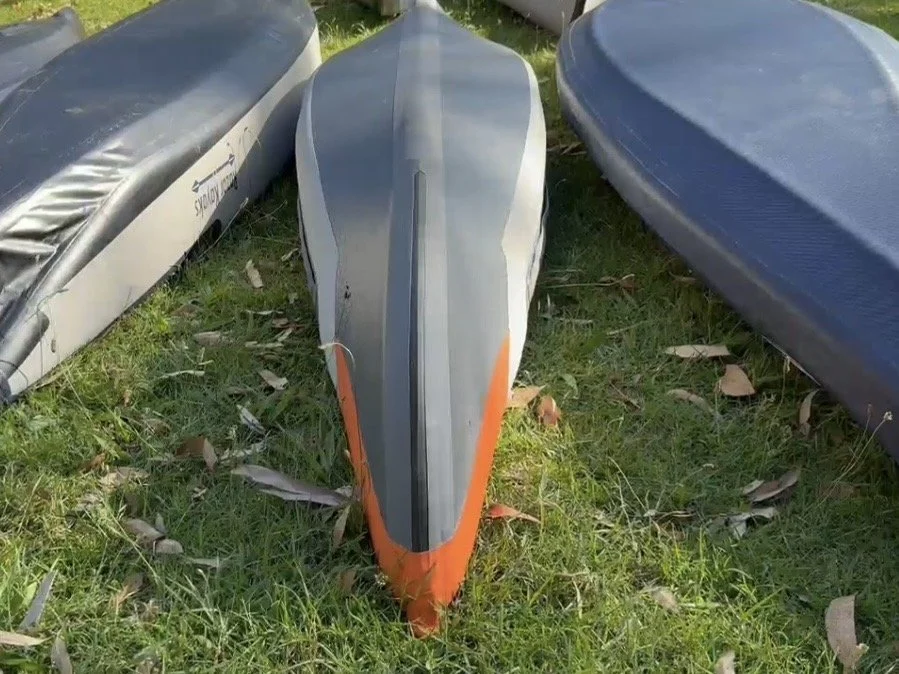
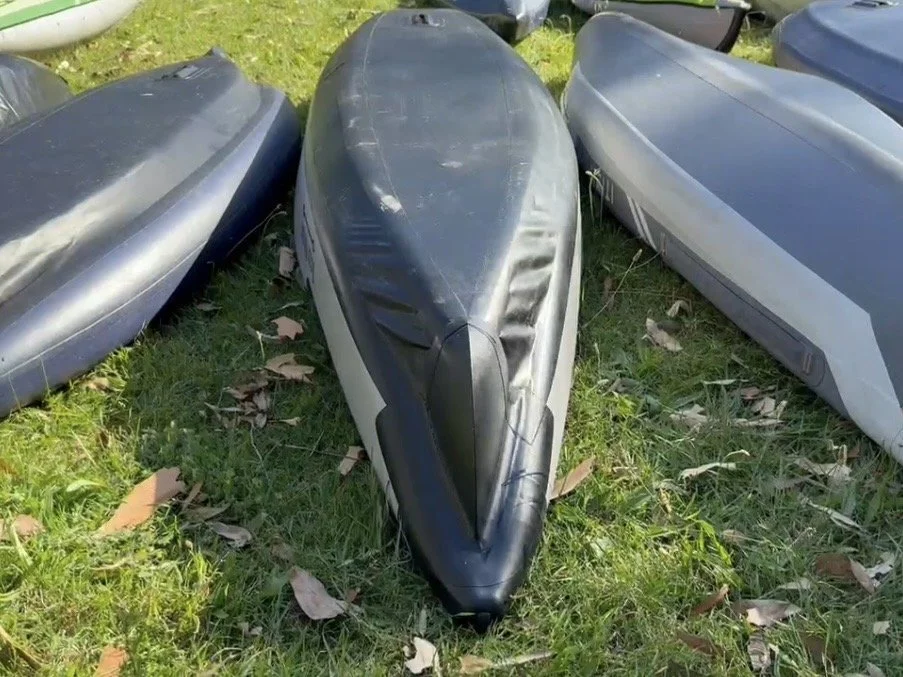
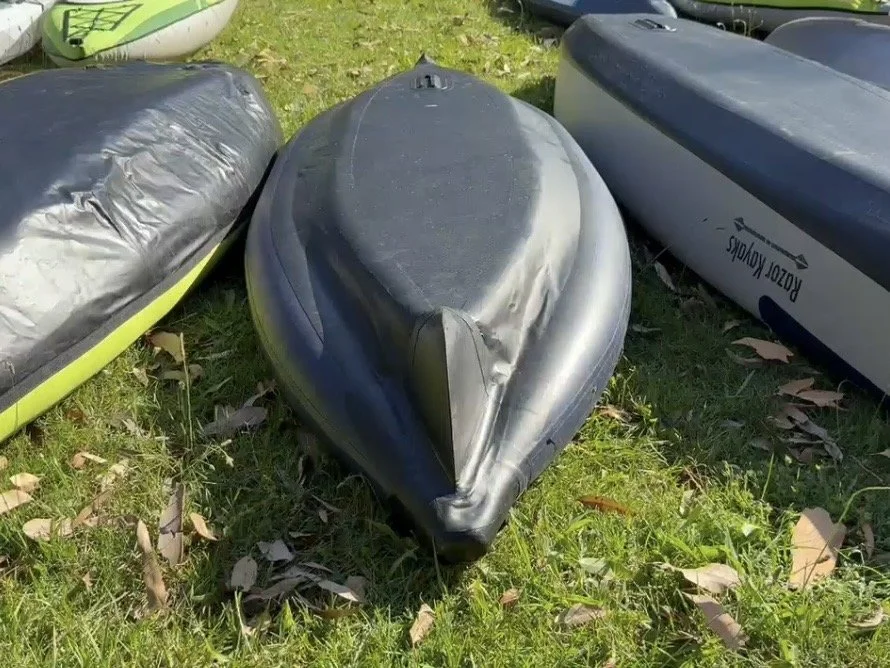
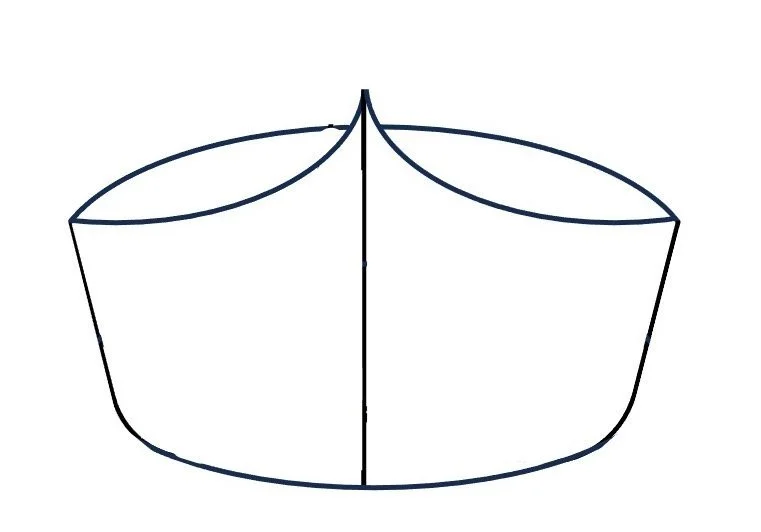
Curved drop-stitch hulls are one of the newer developments in inflatable kayak design. Rather than flat panels joined at angles, these use shaped folds in the drop-stitch material to approximate the smooth, flowing curves you'd normally only find on a hard-shell kayak, without making setup any more complicated.
The high-pressure construction helps them glide cleanly through the water, and the curved underside brings a sense of secondary stability that's pretty rare in full drop-stitch designs. They track well without feeling locked in, so you still get decent maneuverability alongside the speed and efficiency. It's a well-rounded package.
Perfect for: All-around paddlers who want a good mix of speed, stability, and easy handling across different water conditions.
Curved Drop‑stitch Hulls
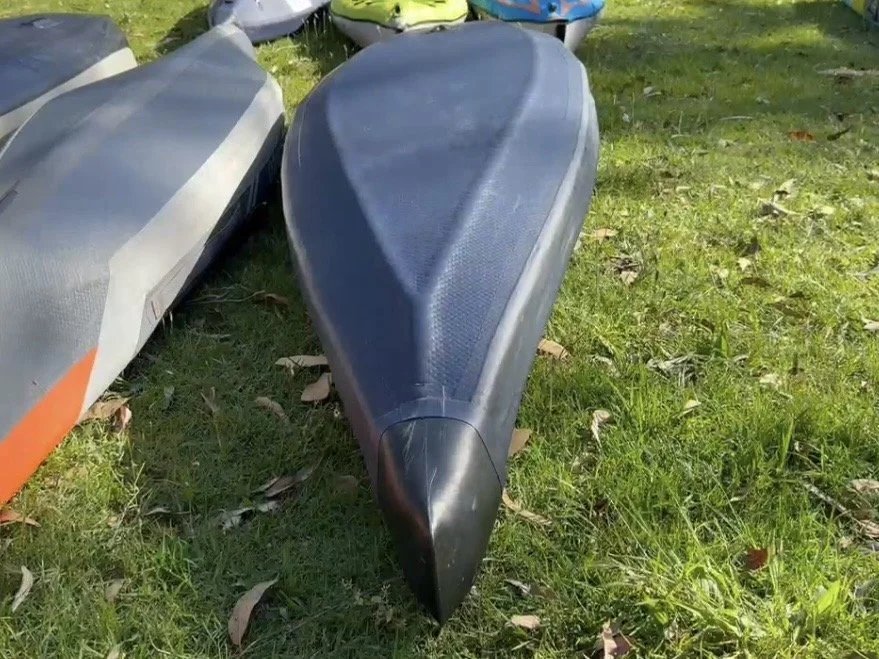
View from the bow of a typical hard‑shell kayak hull design, showing the similar profile to a curved drop‑stitch hull.
| Hull Shape | Paddling Efficiency | Speed | Stability | Manoeuvrability | Best For |
|---|---|---|---|---|---|
| I-Beam Hull | Low to Moderate: Lower pressure (1–3 psi) creates a softer floor and more flex, reducing efficiency | Moderate | High: Large side tubes give strong primary stability | Moderate: Softer structure can feel less precise when turning | Beginners wanting affordable, entry-level kayaks |
| Drop-Stitch Floor + Side Tubes | Moderate to High: Rigid floor improves power transfer compared to i-beam | Moderate to Fast | High: Side tubes offer strong stability, popular for fishing | Moderate: Stable but not overly reactive | Beginner, recreational and fishing paddlers |
| ‘Bathtub’ Shape Drop-Stitch | High: Inflates to 8–10 psi, very stiff and efficient | Fast: Longer, narrower profile improves glide | Moderate to Low: Less forgiving once tilted off flat surface | Moderate: Tracks well but less forgiving in turns | Touring and fitness paddlers |
| V-Shaped Hull | High: Keel-style design improves tracking and glide | Fast: Excellent straight-line performance | Low: Can feel tippy, especially narrow models | Low: Harder to turn due to strong tracking | Long, straight paddles on calm water |
| Curved Drop-Stitch Hull | Very High: High-pressure structure with hard-shell-like shape | Fast: Efficient through water | High: Curved underside improves secondary stability | High: Tracks well but still responsive in turns | All skill levels wanting balance and versatility |
Vinyl
Vinyl is the entry point for inflatable kayak materials, and you'll find it on plenty of budget-friendly models. It's lightweight, flexible, and not too difficult to repair with a patch kit when needed. If you've ever owned an air mattress or a kids' pool toy, you already have a pretty good sense of what basic vinyl feels like. Thickness matters a lot here: thinner, smoother vinyl wears out faster, and kayaks built entirely from it tend to have a shorter lifespan than those using tougher materials. Vinyl also breaks down more quickly when exposed to strong UV rays and saltwater, so it's not the best pick if you're planning regular trips to the coast or paddling in intense sun.
Materials
Not all inflatable kayaks are built the same, and a big part of that comes down to what they're made from. The material affects everything from how the kayak feels on the water to how long it lasts and how much upkeep it needs. Before settling on a kayak, it's worth thinking about how often you plan to paddle, where you'll be using it, and how much punishment it's likely to take.
Fabric‑covered PVC
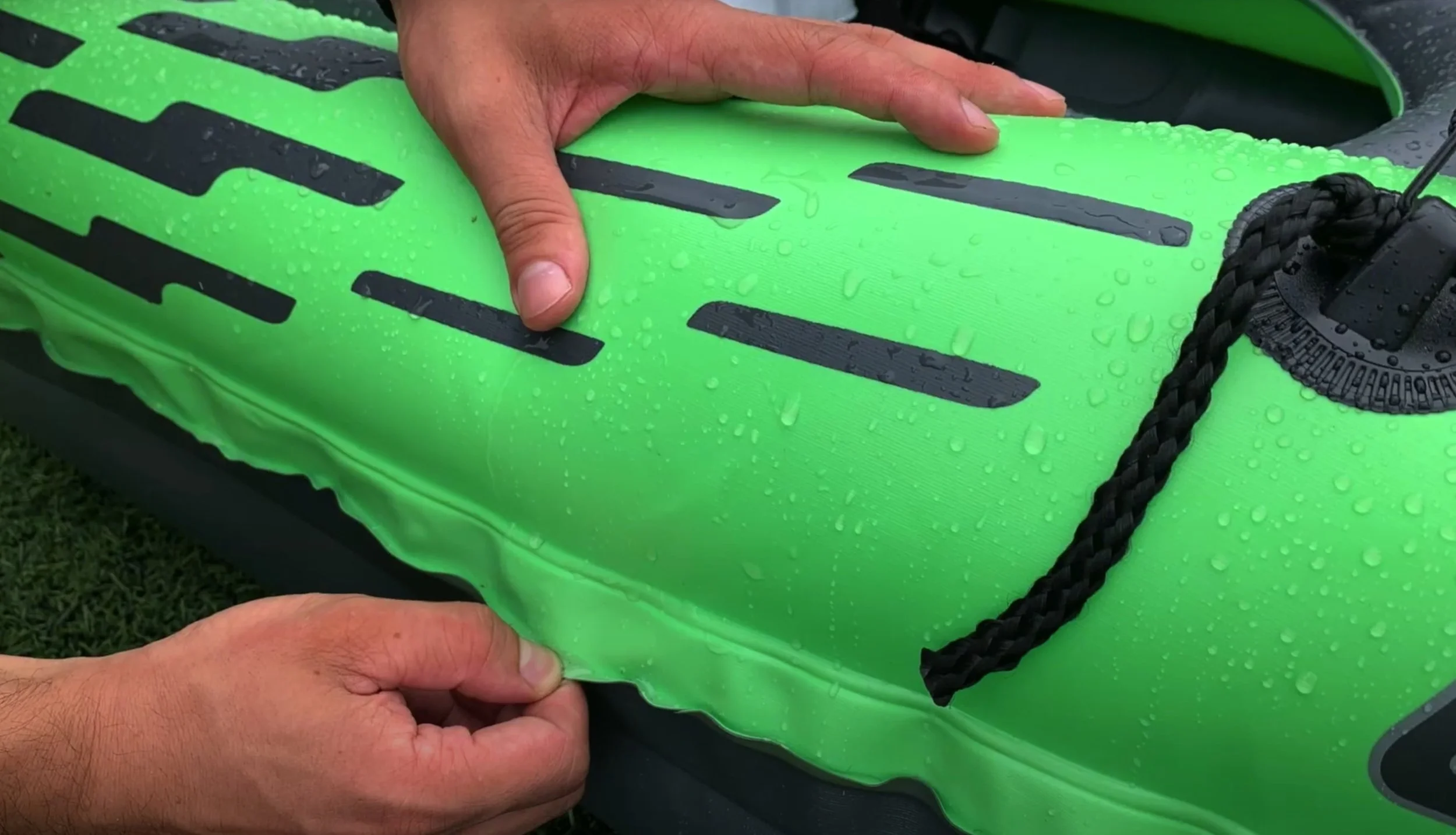
Fabric-covered PVC sandwiches inner PVC air tubes inside a fabric outer shell, usually a heavy-duty polyester. The fabric layer does a decent job of protecting against scrapes and bumps, and some paddlers appreciate the softer feel it gives underfoot and along the sides. On some models, the outer cover unzips so you can swap out a damaged inner tube without replacing the whole kayak. The downsides are that the textured surface creates a bit more drag in the water, and it holds onto moisture, taking significantly longer to dry than bare PVC or vinyl. Packing it away damp is a real mold risk, which is something to keep in mind if you're storing it in a garage or shed.
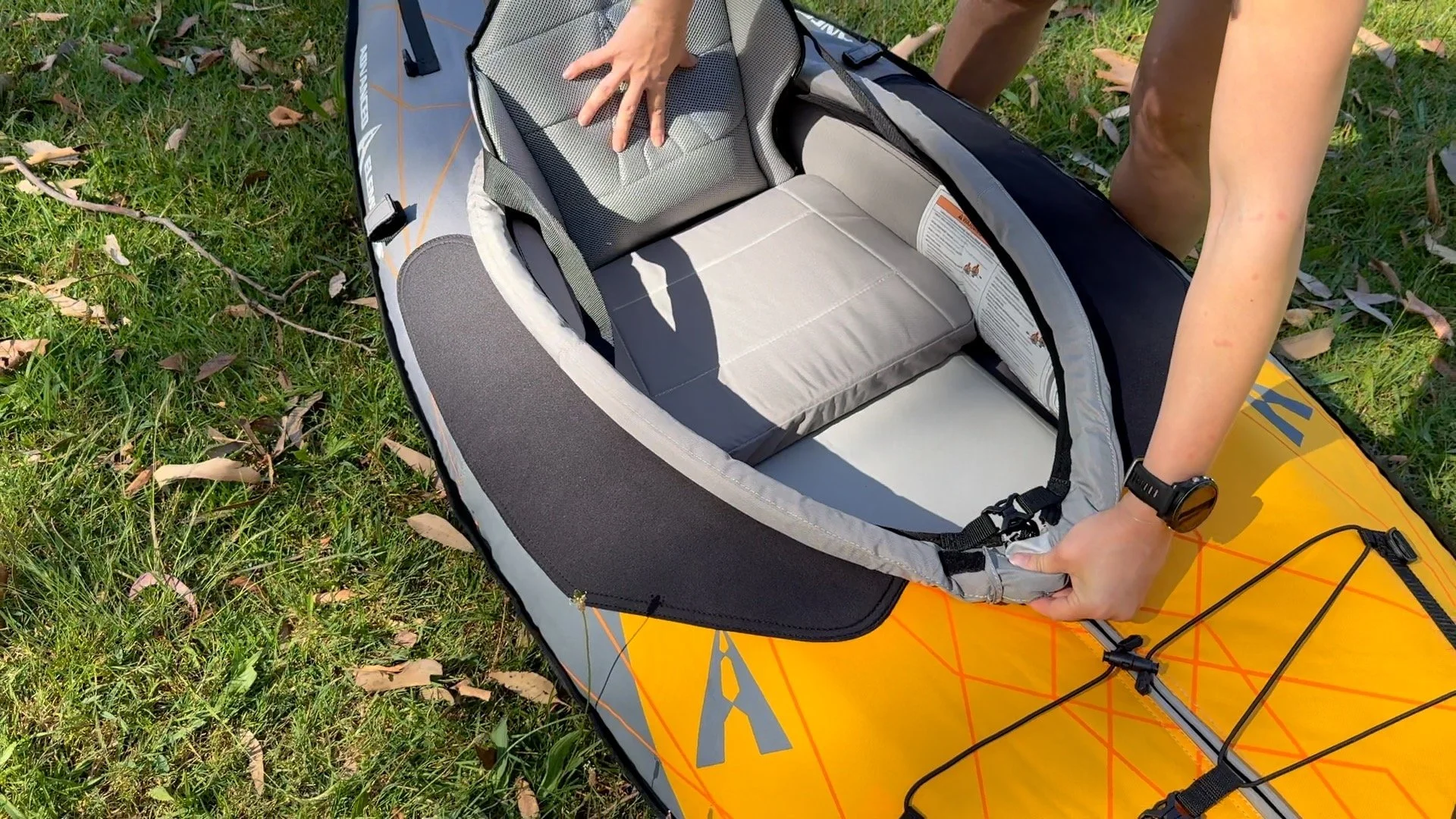
Reinforced PVC
Reinforced PVC is what you get when you take thick PVC, often around 1000 denier, and embed a strong woven mesh inside it. The result is a tough, puncture-resistant material similar to what you'd find on the tubes of commercial rescue or work boats. The outer surface is smooth, which helps it move cleanly through the water and dry off quickly after use. It's heavier and pricier than basic vinyl or lighter PVC grades, but the durability and on-water performance make it the go-to material for mid-range and higher-end inflatable kayaks.
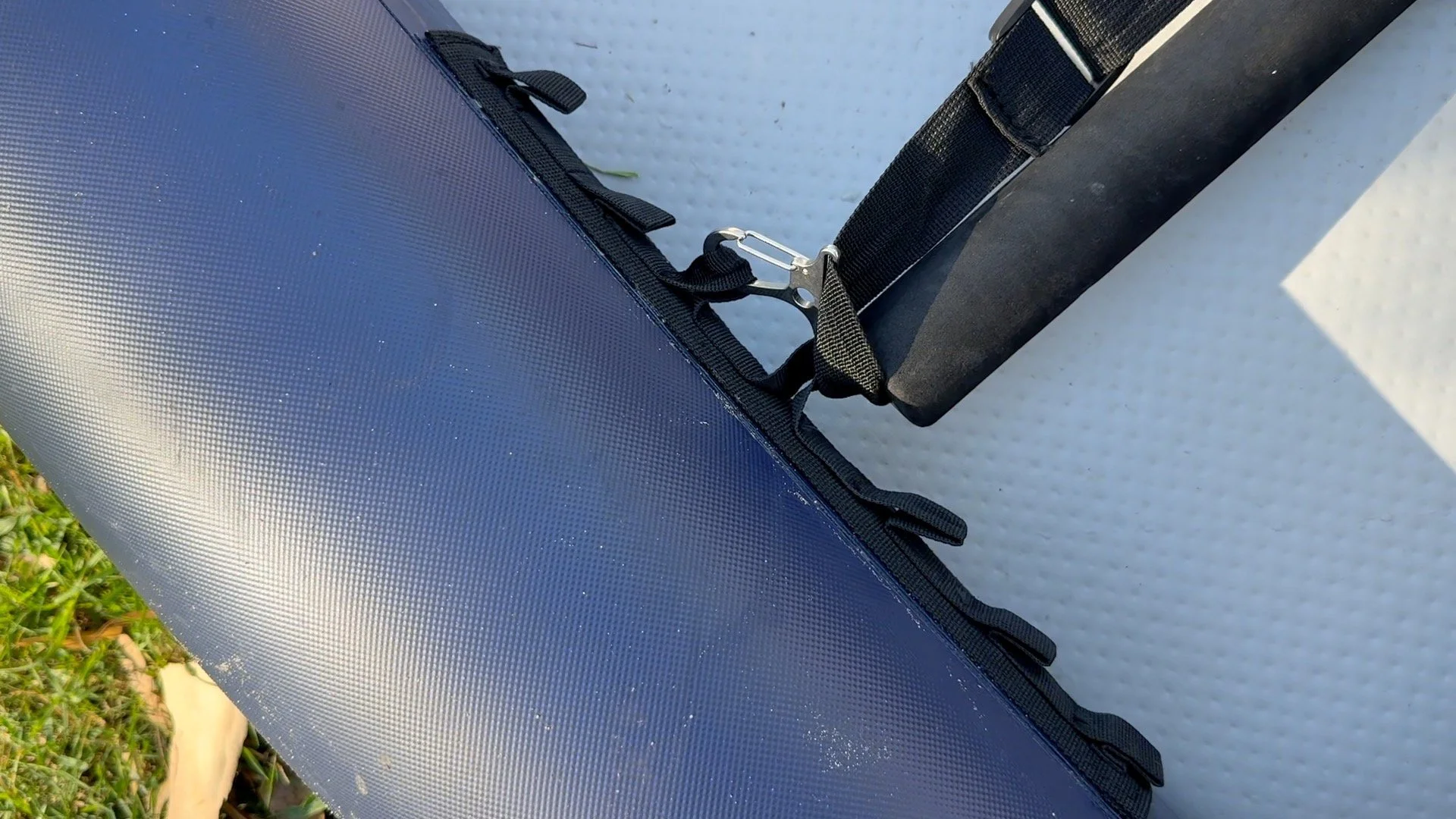
TPU
TPU, or Thermoplastic Polyurethane, is the premium option you'll find on higher-end inflatable kayaks and packrafts. It's used as a coating over nylon or polyester fabric and brings some real advantages over PVC, including better puncture and abrasion resistance, stronger UV protection, and greater flexibility overall. TPU also allows for welded seams rather than glued ones, which tend to be more reliable and less prone to leaking over time. It's also a more environmentally friendly choice than PVC, which is a bonus for paddlers who care about that sort of thing.
Nitrylon
Nitrylon is made by laminating synthetic nitrile rubber onto a polyester fabric base. It's heavier than standard PVC, but that weight comes with a payoff in toughness. Nitrylon holds up well against punctures and abrasion, making it a solid choice for paddlers who spend a lot of time on rocky rivers or in areas with submerged debris. It also tends to outlast PVC over the long haul, which is why you'll often see it used on floors and lower side tubes where wear is most concentrated.
Hypalon/CSPE
Hypalon, now more commonly labeled as CSPE in newer products, is one of the most durable materials used in inflatable watercraft. It handles UV exposure, saltwater, and chemical contact better than most alternatives, and it holds up well with repeated, heavy use over many years. You'll typically find it on professional-grade or expedition-level inflatables, which is reflected in the price. If you're paddling year-round in demanding conditions, from hot desert rivers to cold coastal waters, Hypalon is built for that kind of lifestyle.
Drop-Stitch Fabric
Drop-stitch fabric is what makes modern high-performance inflatable kayaks possible. The construction uses thousands of tiny internal threads connecting the top and bottom layers of the panel, which stops them from bowing outward under pressure and allows the kayak to be inflated to much higher PSI than a standard air chamber ever could. The result is a surface that feels almost board-stiff when fully inflated. In practice, drop-stitch floors and full drop-stitch hulls give you a firm, stable platform that tracks better, handles chop more confidently, and generally just feels more like a real kayak on the water. Learn more about what drop-stitch is in our explainer video!
| Material | Durability | Drying Time | In-water Performance | UV Resistance | Weight | Price |
|---|---|---|---|---|---|---|
| Vinyl | Poor | Fast | Smooth | Poor | Very light | Cheap |
| Fabric-covered PVC | Good | Slow | Can have drag | Depends on fabric used (look for UV-stabilised) | Heavier | Medium |
| Reinforced PVC | Good | Fast | Smooth | Good | Medium | More expensive |
Construction Methods
How an inflatable kayak is put together has a direct impact on how it performs and how long it holds up. Here's a look at the main construction elements worth understanding before you buy.
Seams
Seams are either welded or glued, and both methods can produce a strong result when done right. Heat welding is the most common approach with vinyl and PVC: the material is heated until it becomes pliable, then pressed together so the two surfaces fuse into one. Done well, welded seams tend to outlast basic glued joins. That said, adhesive technology has come a long way in the past decade, and a properly applied PVC glue bond can be just as strong and reliable as a weld in many cases.
Drop‑stitch
Drop-stitch construction is what separates a high-performance inflatable from a glorified pool toy. Two strong outer layers of PVC are connected internally by thousands of tiny polyester threads. When you pump air into the chamber, those threads hold the surfaces flat and parallel instead of letting them bow out into a round shape. The result is a rigid, board-like panel with very little flex. In practical terms, this matters a lot. A stiffer hull means more of your paddle stroke actually moves the kayak forward rather than being absorbed by a soft, wobbly floor. It also holds its shape better when you're carrying gear or paddling with a second person. Kayaks that use drop-stitch in the floor or throughout the entire hull can feel surprisingly close to a hard-shell on flat water, rivers, and open coastal stretches.
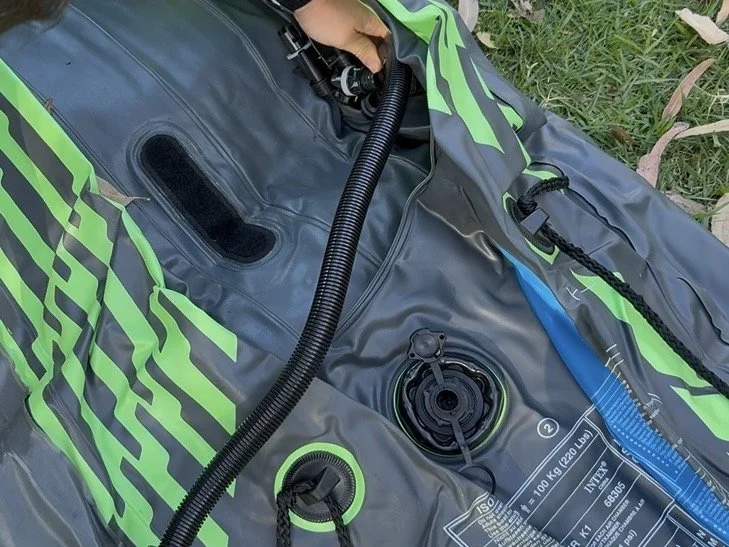
Valves
Inflatable kayaks use several different valve types, each with its own approach to inflation and deflation:
Halkey‑Roberts‑style valves: Sometimes called push-push valves, these have a spring-loaded center pin that toggles between inflation and deflation modes when pressed. Around the base you'll find small notches where the pump nozzle locks in to create a secure connection. These valves are built to handle higher pressures, so you'll typically find them on drop-stitch floors and chambers running anywhere from 5 to 15 psi. A few brands, including Advanced Elements, use their own slightly modified version that looks nearly identical but is a different size, so it's worth double-checking that your pump fittings are compatible with your specific kayak before heading out.
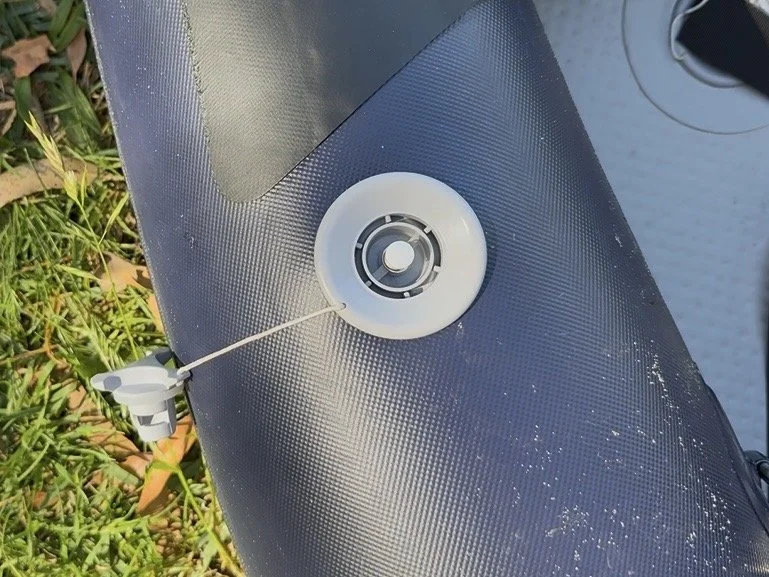
Boston valves: Boston valves have two caps that thread into a fixed base. With just the outer cap removed, the valve stays sealed and you can push air in through the pump. Unscrew the inner section from the base entirely and the valve opens up fully, letting air escape quickly for fast deflation. The pump fitting for a Boston valve is typically a smooth cylinder with no locking notches, so it just pushes straight in. You'll find these most often on lower-pressure chambers like side tubes, which usually sit somewhere in the 1 to 3 psi range.
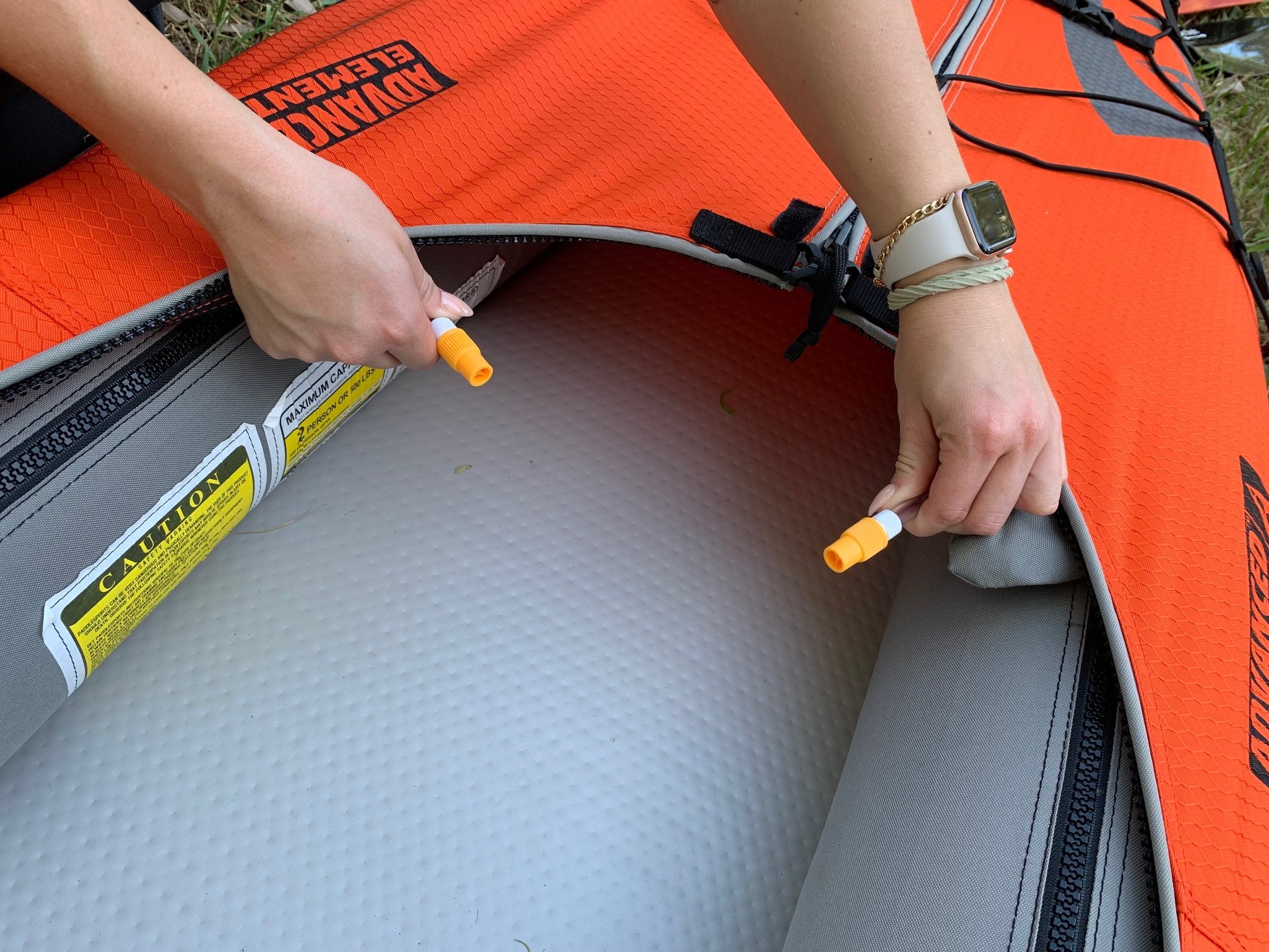
Twist‑lock valves: Twist-lock valves are the small, slim valves you'll find on accessories like inflatable seats or the coamings around sit-in cockpit openings. Twist one way to open, twist back to close. They inflate quickly and are easy to use, but they're really only intended for smaller sections of the kayak rather than the main air chambers. Don't expect to find these handling any of the heavy lifting on the hull itself.
Considerations for US Conditions
The US covers an enormous range of climates and paddling environments, so what matters most will depend a lot on where you live and where you like to paddle. That said, here are the main environmental factors worth keeping in mind when choosing your materials.
Sun and UV exposure: UV is a serious issue across much of the country, especially in the Southwest, Southeast, and at higher elevations where the sun is intense for much of the year. Even tough materials can fade and degrade over time with repeated sun exposure. If your kayak has a fabric cover, look for one that's UV stabilized so it doesn't break down, bleach, or lose its structure after a few seasons. Mesh-reinforced PVC generally holds up better to long-term sun exposure than basic vinyl or fabric-covered options.
Cold weather and winter storage: Colder temperatures make inflatable materials stiffer and more brittle, especially if the kayak is stored folded for months at a time. If you're in the Northeast, Midwest, or Pacific Northwest, try to keep your kayak somewhere frost-free during winter, like a garage or basement, and consider leaving it loosely and partially inflated to prevent permanent crease damage. Humid climates also create mold risk, particularly for fabric-covered hulls, so make sure the kayak is completely dry before you pack it away.
Rocky launches and river hazards: Whether you're scraping off a gravel bar in Montana, launching from a rocky shoreline in Maine, or dragging across a pebbly beach on the Great Lakes, abrasion is a real concern. Look for kayaks made from reinforced PVC or fabric-covered materials that can handle regular contact with rough surfaces without needing constant patching.
Saltwater exposure: Coastal paddlers from the Gulf Coast to the Pacific Northwest need to think about salt. Over time, saltwater works its way into metal fittings and accessories and causes corrosion, even on marine-grade hardware. It can also stiffen certain fabrics. The fix is simple: rinse your kayak thoroughly with fresh water after every saltwater session. Check out our Maintenance and Storage section for a full rundown on keeping things in good shape.
Wind and open water chop: Big lakes, bays, estuaries, and coastal waters can kick up wind and waves faster than you'd expect. Drop-stitch floors and narrower hull profiles tend to handle chop better and feel more stable in those conditions, while wider designs with side tubes offer a bit more initial reassurance when things get lively on the water.
On the Water:
Performance Factors
With materials and hull shapes covered, let's get into how all of that actually translates to how a kayak feels and handles out on the water.
-
Speed comes down to how efficiently the kayak moves through the water relative to the effort you're putting in. A cleaner, more streamlined hull carries you further with each stroke, and that generally means a longer, narrower design with a smooth outer surface.
Look for: Curved drop-stitch, bathtub-style, or V-shaped hulls with a reinforced PVC skin. These designs cut through the water with less resistance, whether you're on a glassy lake, a slow river, or open coastal water.
-
Tracking is how well the kayak holds a straight line without you constantly having to correct your course. A well-tracking kayak moves forward cleanly and predictably, with minimal side-to-side wandering. Some hulls are shaped to help with this naturally, and most kayaks come with a removable skeg, which is a small fin at the stern, that makes a noticeable difference to straight-line running.
Look for: Any hull type that includes a removable skeg. Drop-stitch floors also help here by staying rigid and cutting through chop rather than flexing with it.
-
Stability breaks down into two types. Primary stability is how steady the kayak feels in calm or mildly choppy conditions with only slight side-to-side movement. Secondary stability is how it behaves when leaned further over, whether from bigger waves or from intentional edging during a turn.
Inflatables handle this a bit differently than hard-shells. The large side tubes on many designs provide good secondary stability if you do tip, acting almost like outriggers. Flat-walled bathtub and V-shaped drop-stitch hulls can feel less forgiving once they move away from upright, tending to keep rolling until they reach the next flat surface. Curved drop-stitch hulls behave differently: the gradual curvature helps the kayak naturally want to return to an upright position, which feels more intuitive in varied conditions.
Look for: Curved drop-stitch hulls, or designs that pair a drop-stitch floor with inflatable side tubes.
-
Maneuverability is simply how easily you can turn the kayak. Can you drop a paddle blade and spin on a dime, or does changing direction take several hard strokes? This matters most for whitewater paddling, tight river sections, or anyone who just wants something fun and responsive. Shorter, wider hulls turn far more readily than long touring designs, and built-in keels, while great for tracking, can work against you when you need to change direction quickly.
Look for: Curved drop‑stitch hulls, i‑beam floors with side tubes or drop‑stitch floors paired with side tubes.
-
If you're a larger paddler or planning multi-day trips with a full gear load, pay attention to how a kayak performs when it's heavily loaded. Some models sit noticeably lower in the water near their weight limit and become sluggish and harder to manage. Drop-stitch kayaks generally handle heavier loads better than basic inflatables because the rigid construction resists flexing and distortion under weight. Full drop-stitch hulls tend to be the most capable here. Hull shape plays a role too: a kayak that's tuned for peak efficiency at half its load capacity may feel like a completely different boat when you're pushing 80 to 100 per cent of the limit.
Look for: Full drop-stitch hulls, particularly curved drop-stitch or V-shaped designs, for the best load-handling performance.
Inflation Time
How long inflation takes depends on the pump you're using, the number of chambers, and the pressure each one needs. A strong paddler working a triple-action hand pump will get there noticeably faster than someone using a basic double-action pump. Electric pumps can speed things up considerably, though they have their own tradeoffs worth knowing about.
Higher-pressure chambers, like drop-stitch floors and hulls, take more time and effort to fill than lower-pressure side tubes. The payoff is a stiffer, more responsive kayak that handles much better on the water, so it's worth the extra few minutes.
One of the biggest selling points of an inflatable kayak is how much easier it is to deal with compared to hauling a hard-shell around. That said, setup times and complexity do vary from model to model, so here's what to expect.
Valve Types
Different kayaks use different valve types, and when a single kayak has more than one type, you may need to swap out your pump attachment partway through inflation. It's a minor inconvenience, but worth knowing about ahead of time. More chambers also means more inflation points, so a fully featured touring or fishing kayak will naturally take longer to set up than a simple recreational model. For more detail on the specific valve types, head back to our Materials and Construction section.
Fitting Additional Parts
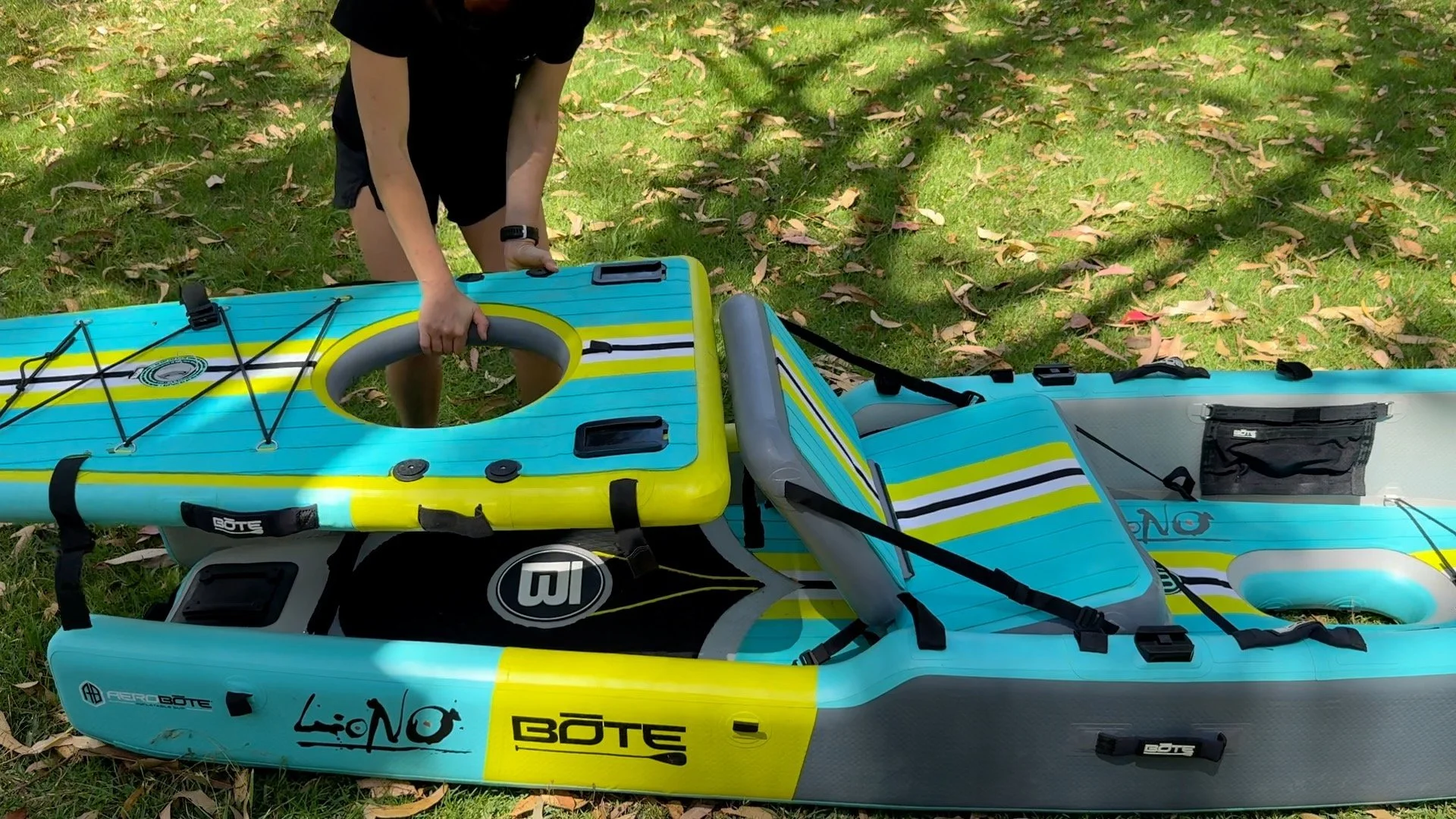
Inflating the hull is just one part of the setup process. Most kayaks need a few extra pieces fitted before they're ready to launch.
Seats are the obvious one. Solid foam seats usually clip in quickly and are ready to go in seconds. Inflatable seats take a bit longer since you need to pump them up and get them positioned just right before locking them in place.
Footrests are another common addition. Some attach with Velcro or clip directly into fittings along the floor and are quick to adjust, while others use rigid metal or plastic frames that take a little longer to install the first time. Once you've dialed in the position, many paddlers just leave them set for future trips.
Some kayaks also include structural plastic components like bow and stern stiffeners or spray guard supports. These add a bit of time to the process but can make a real difference to how the kayak sits in the water and performs underway. A skeg, if your kayak comes with one, is usually the easiest part of the whole setup: most slide and lock into position in just a few seconds, and the improvement in straight-line tracking is well worth the effort.
Foldable Kayaks
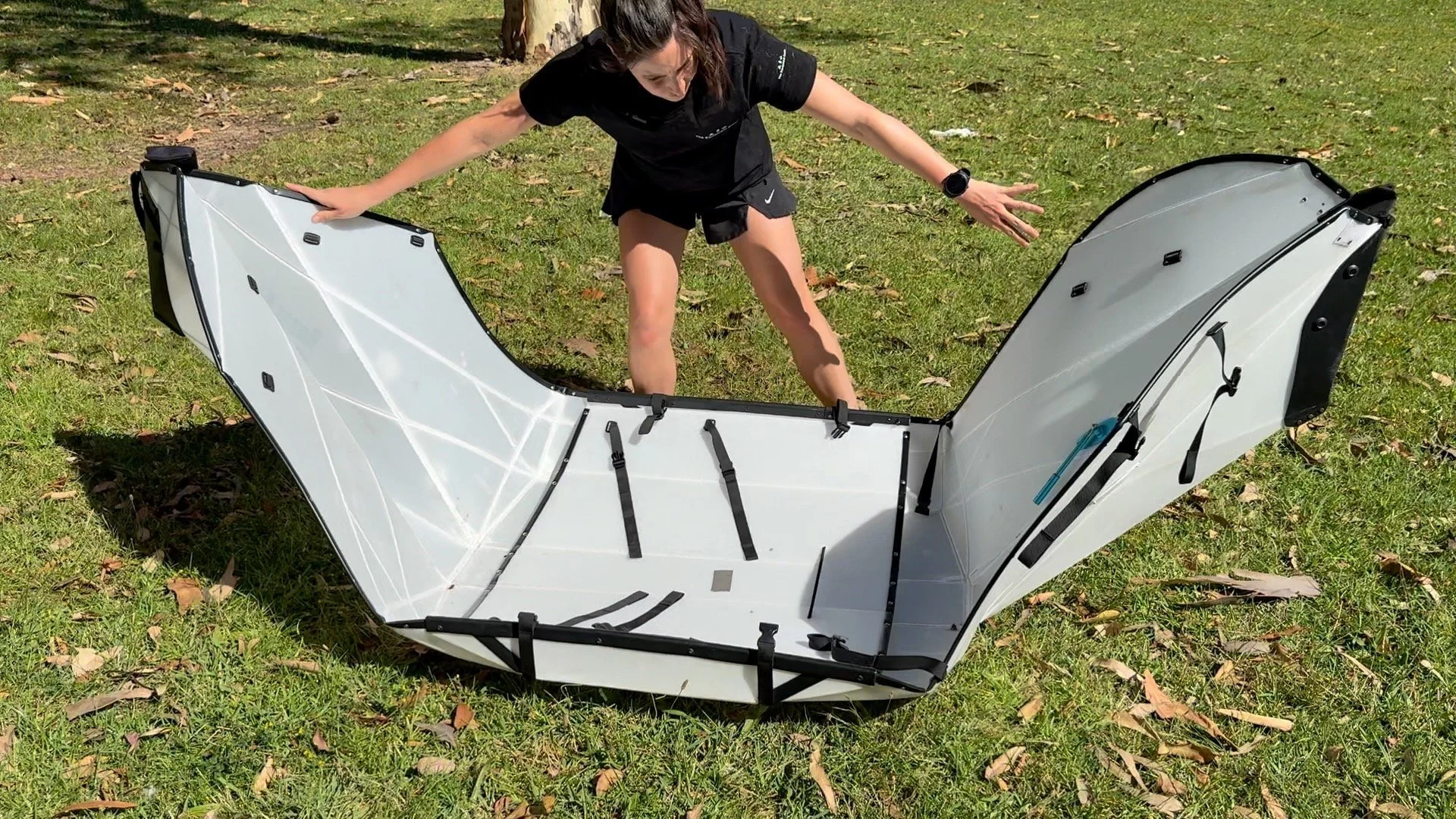
Foldable kayaks have a steeper learning curve than inflatables when it comes to setup. Before your first attempt, it's worth finding a video walkthrough specific to your model so you know what you're dealing with. The first several builds can feel awkward and stiff, and some parts may need a firm push or pull to click into place. Stick with it though, because once the routine clicks it becomes second nature, and the reward is a kayak that feels noticeably closer to a hard-shell on the water, which a lot of paddlers really appreciate.
Drying Time
Before you pack any inflatable kayak away, it needs to be completely dry. Storing it damp is a fast track to mold and mildew, which can degrade the material over time. PVC and vinyl kayaks are the easiest to deal with: a quick wipe-down with a towel followed by a short airing session is usually enough. Fabric-covered hulls are a different story. They hold onto moisture and can take many hours or even a full day or two to dry out properly, especially in cooler or humid conditions. Factor that into your post-paddle routine if you own one.
Deflation
Letting the air out is typically one of the fastest parts of the whole process, regardless of which valve system your kayak uses. How much air you release depends on your storage plan. Many manufacturers recommend keeping a little air in the kayak and rolling it loosely rather than deflating it completely, which helps protect the seams from developing hard creases over time. If you need to get it back into its carry bag for transport or travel, you'll need to push or pump out more air to get it compact enough. Storage bag sizes vary quite a bit between brands, so how tightly you need to pack it will depend on your specific model.
Accessories
Pumps
Choosing the right pump can make a real difference to how enjoyable your pre-paddle routine is. Here's a breakdown of the main options:
Double-action hand pumps move air on both the up and down stroke, giving you a steady flow with each cycle. They're usually the most affordable option and are commonly included in kayak packages. That said, they're also the slowest of the hand pump options, so expect to put in some work before you hit the water.
Triple-action hand pumps are designed to shift a higher volume of air per stroke, which means you can get your kayak up to pressure faster than with a double-action pump. The tradeoff is that they demand more physical effort, particularly toward the end when you're pushing against higher pressure. Most models have a flow adjustment so you can dial things back if it starts feeling like a workout. Some kayak bundles include a triple-action pump as standard.
12V car-powered electric pumps plug into your vehicle's power outlet and do the work for you. You set the target pressure, connect the hose, hit the button, and walk away. Very convenient, but you're tethered to your vehicle, which limits where you can realistically launch from.
Battery-powered electric pumps have improved a lot in recent years. Older models often struggled with the volume needed for a full kayak, but newer versions handle it well. Look for one that charges via USB-C, holds enough charge for multiple inflations on a single battery, and ideally has a 12V car adaptor as a backup for longer trips or multi-day outings.
Compressors are worth considering if you already own one, since several kayak brands sell compatible adaptors. It's a practical solution at home or in a garage. If your compressor doesn't have a built-in pressure gauge, keep a close eye on things while inflating and regularly check the firmness of the tubes and floor by hand to avoid accidentally overinflating.
Paddles
A four-piece paddle is generally the most practical choice for inflatable kayak users. Breaking down into four sections means it fits neatly inside your kayak bag or can be strapped to the outside, making it easy to transport whether you're driving to a launch spot, hiking in, or traveling to a destination paddle.
Aluminum paddles use an aluminum shaft with plastic blades. They're the most affordable option and get the job done, though they're heavier than the alternatives and can cause more arm fatigue on longer outings.
Fiberglass paddles are typically constructed entirely from fiberglass, shaft and blades both, which keeps them light, strong, and pleasantly responsive in the water. A solid mid-range choice for most paddlers.
Carbon fiber paddles are the lightest and stiffest option available, with the entire paddle built from carbon fiber aside from the metal ferrule connecting the sections. If you're covering longer distances on rivers, lakes, or coastal water, the weight savings can make a real difference to how your arms feel by the end of the day.
One quick tip on technique: the shorter edge of the blade is the one that goes into the water, not the longer one. It's a surprisingly common mistake for newer paddlers. Also, paddle leashes aren't essential, but if you like to drift, take pictures, or stop for breaks on the water, a leash will keep your paddle from floating off while your hands are busy.
Bags
A backpack-style carry bag is the most practical choice if you're walking any real distance between your car, trailhead, or home and the water. For larger kayaks, a bag that unzips fully around the opening makes packing significantly easier, especially at the end of a session when you're tired. Slightly roomier is almost always better than a tight squeeze, so don't stress if your bag has a bit of extra space.
Motors
A motor can be a genuinely useful add-on if you're covering longer distances, paddling against current, or heading out with kids and want a backup option. Most attach either through the fin slot or mount at the stern. Always verify that the motor you're considering is rated for use with your specific kayak, and where possible, stick with a motor from the same manufacturer to avoid fit and compatibility issues.
Fishing, Camera, and Gear Mounts
Some inflatable kayaks come with integrated mounting tracks or bars for attaching rod holders, action cameras, or other accessories, though this is still more the exception than the rule. On PVC-hulled kayaks, another option is to glue mounts directly to the surface using a PVC-compatible or marine-grade adhesive, usually specified by the accessory manufacturer. Whether you're going with plastic or metal fittings, look for marine-grade stainless steel on any metal components so they can handle regular exposure to water and the occasional saltwater outing without corroding.
Sails
Sails are a niche accessory, but some inflatable kayaks are designed to accept a simple sailing rig. Like a motor, a sail gives you a helping hand and can make longer crossings or downwind runs much more enjoyable. That said, you do need to be comfortable reading and working with the wind before it becomes an asset rather than a handful. Before purchasing a rig, check how the mast attaches to your specific kayak and think about whether the sail will obstruct your sightlines while you're paddling normally.
Personal Flotation Devices (PFDs)
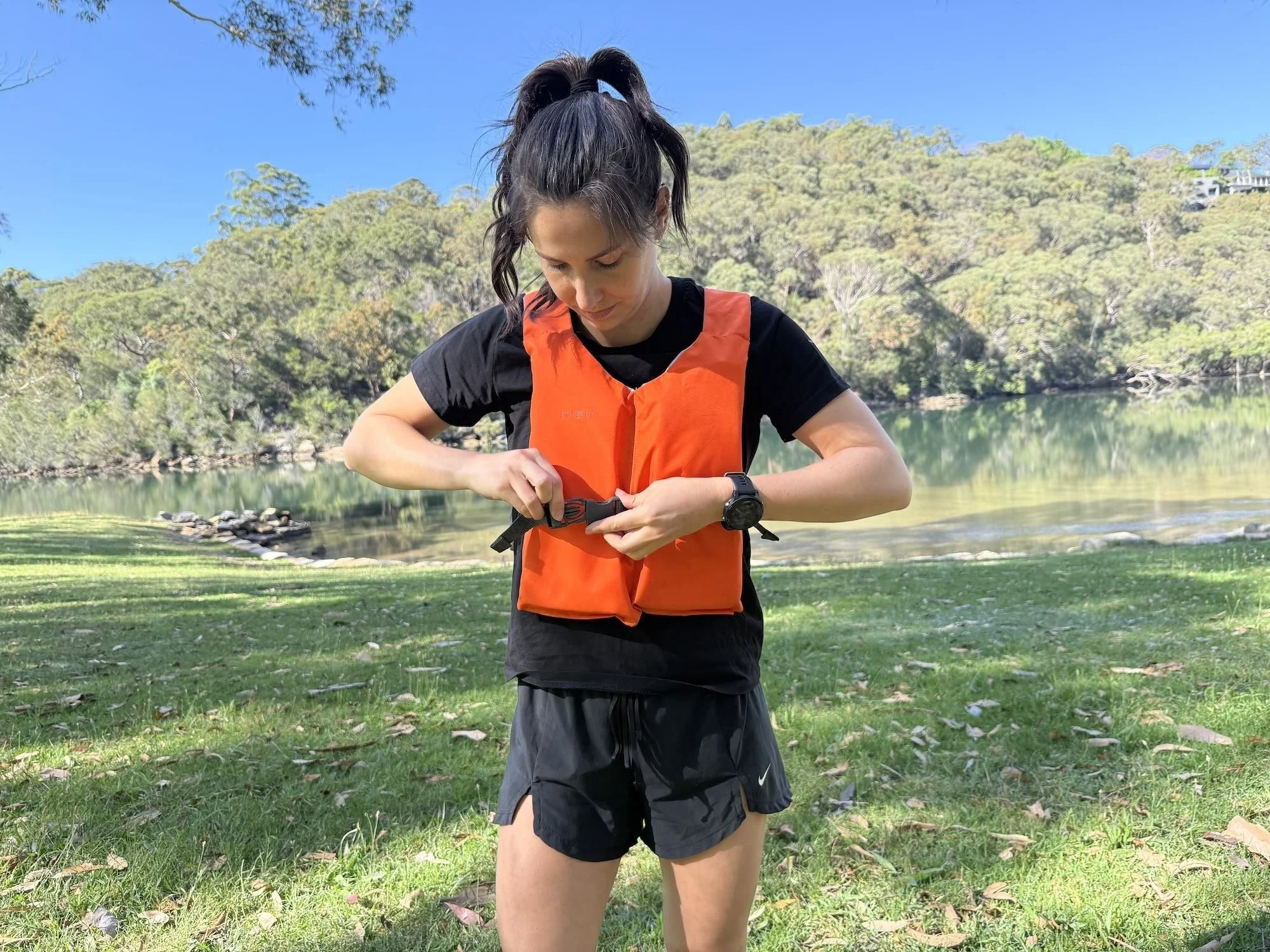
A properly fitting PFD is one of the most important pieces of gear you can own as a paddler. In the US, the Coast Guard requires that every vessel carry a wearable PFD for each person on board, and many states have additional rules about when they must actually be worn. Beyond the legal side of things, wearing one is just smart practice any time you're on the water. Look for a PFD specifically designed for paddlesports rather than a general boating life jacket, as these are cut to allow a full range of arm movement and are far more comfortable for extended paddling. Fit matters too, so try it on and make sure it's snug without being restrictive.
Spray Skirts
Spray skirts, sometimes called spray decks, are only compatible with sit-in kayaks that have a cockpit coaming, which is the raised lip around the cockpit opening. If your kayak has one, a spray skirt is a great addition for keeping water out in choppy conditions, wind, or rain. They come in a range of sizes, so you'll need to check both the waist tunnel size for your own fit and the deck diameter for your specific cockpit. A skirt that doesn't seal properly around the coaming won't do much good when things get wet.
General Watercraft Safety
Always wear your PFD. The US Coast Guard requires one on board for every person, and many states require them to be worn at all times on certain waterways. Beyond the rules, it's just good practice regardless of where or how far you're paddling.
Stick to the manufacturer's stated weight limit for your kayak, including yourself, any passengers, and all your gear. Exceeding it affects stability and performance in ways that can catch you off guard.
If you're heading out solo, especially on bigger water or remote stretches, let someone know your plan. Share your put-in location, your intended route, and when you expect to be back. Keep your phone in a waterproof case or dry bag.
Dress for the conditions and then some. Sun hat, sunglasses, and sun protection for bright days; a waterproof shell and warm layers for wind, cold water, or changing weather. Bring enough food and water for your time on the water, plus a little extra.
Buoyancy and Chamber Redundancy
A well-designed inflatable kayak has multiple independent air chambers, which means a single puncture won't send you to the bottom. You'll still have enough flotation to paddle back to shore or stay afloat while you sort things out.
Some whitewater models include self-bailing ports that allow water to drain out of the cockpit automatically, which is a real advantage when you're dealing with continuous rapids or heavy splash.
Puncture Risk and Prevention
Avoid dragging your kayak over sharp rocks, barnacle-covered surfaces, oyster beds, asphalt, or gravel. Carry it when you can, especially at the put-in and takeout.
Always bring a patch kit, a pump, spare valve cores, and repair adhesive on every trip, even short ones. A small puncture in the right place at the wrong time can ruin a day fast.
Sea, Lake, and River Use
Coastal and ocean paddling: Salt water brings a whole different set of challenges, including swell, surf, tidal currents, and wind that can build quickly. If you're planning ocean or exposed coastal trips, choose a touring or sea kayak with high sides, spray skirt compatibility, or self-bailing ports. Build up your skills and experience in calmer, more sheltered conditions before venturing further out.
Lakes and reservoirs: Flatwater suits almost any inflatable kayak, but don't underestimate how quickly wind can kick up chop on a large lake or open reservoir. Check the forecast before you launch and look for a hull with solid secondary stability if you're paddling somewhere exposed.
Rivers: Whitewater kayaks are purpose-built for moving water and rapids, while touring models are well suited to gentler flows and flatwater river runs. If you're paddling upstream, make sure you have enough in the tank for the return trip, or consider a motor designed for your specific kayak.
U.S Regulatory and Safety Requirements
Paddling regulations in the US are split between federal requirements set by the Coast Guard and state-level rules that vary quite a bit depending on where you are.
Federal Requirements (U.S Coast Guard)
Every kayak must carry at least one Coast Guard-approved Type III or Type V PFD for each person on board. Type III is the standard choice for most recreational paddlers.
Kayaks are classified as vessels under federal law, which means you're expected to follow the same basic rules of navigation as other boats.
Between sunset and sunrise, you're required to have a white light on board that's visible from at least two miles away.
A sound-producing device, like a whistle, is required on all vessels under 39ft. Most paddlers just clip one to their PFD.
State-Level Rules
Rules differ significantly from state to state, so it's worth checking the specific requirements for wherever you plan to paddle. A few general patterns worth knowing:
Most states require children under a certain age, typically 12 or 13, to wear a PFD at all times while on the water. Some states extend this to all paddlers in certain conditions.
Many states require kayaks to be registered, even if they're human-powered. This varies a lot, so check with your state's fish and wildlife or boating authority.
Some states have specific rules for coastal paddling, particularly around ocean inlets, shipping lanes, and designated swimming areas.
Coastal and Open Water Paddling
If you're venturing into open coastal water or offshore areas, consider carrying a VHF radio or a personal locator beacon (PLB) in addition to your standard gear.
Check NOAA forecasts before any coastal trip, and review local Coast Guard sector guidance for the area you're paddling in.
Some harbors and marinas have their own rules around non-motorized vessels, so it's worth a quick check before you show up.
General Best Practices across the U.S
Never head out alone without telling someone your float plan, including where you're launching, your intended route, and when you expect to be back.
Children should always wear a PFD on the water, regardless of local rules.
Inflatable life jackets with auto-inflate mechanisms need regular servicing to make sure the CO2 cartridge and trigger are in working order.
Motorized kayaks may need to be registered differently than paddle-only craft depending on your state.
The American Canoe Association (ACA) and your state's boating authority are the best starting points for detailed, location-specific guidance. Rules can and do change, so always verify current requirements for the specific waterways you plan to use.
A little regular care goes a long way toward keeping your inflatable kayak in good shape, whether you're paddling year-round or storing it through a long off-season.
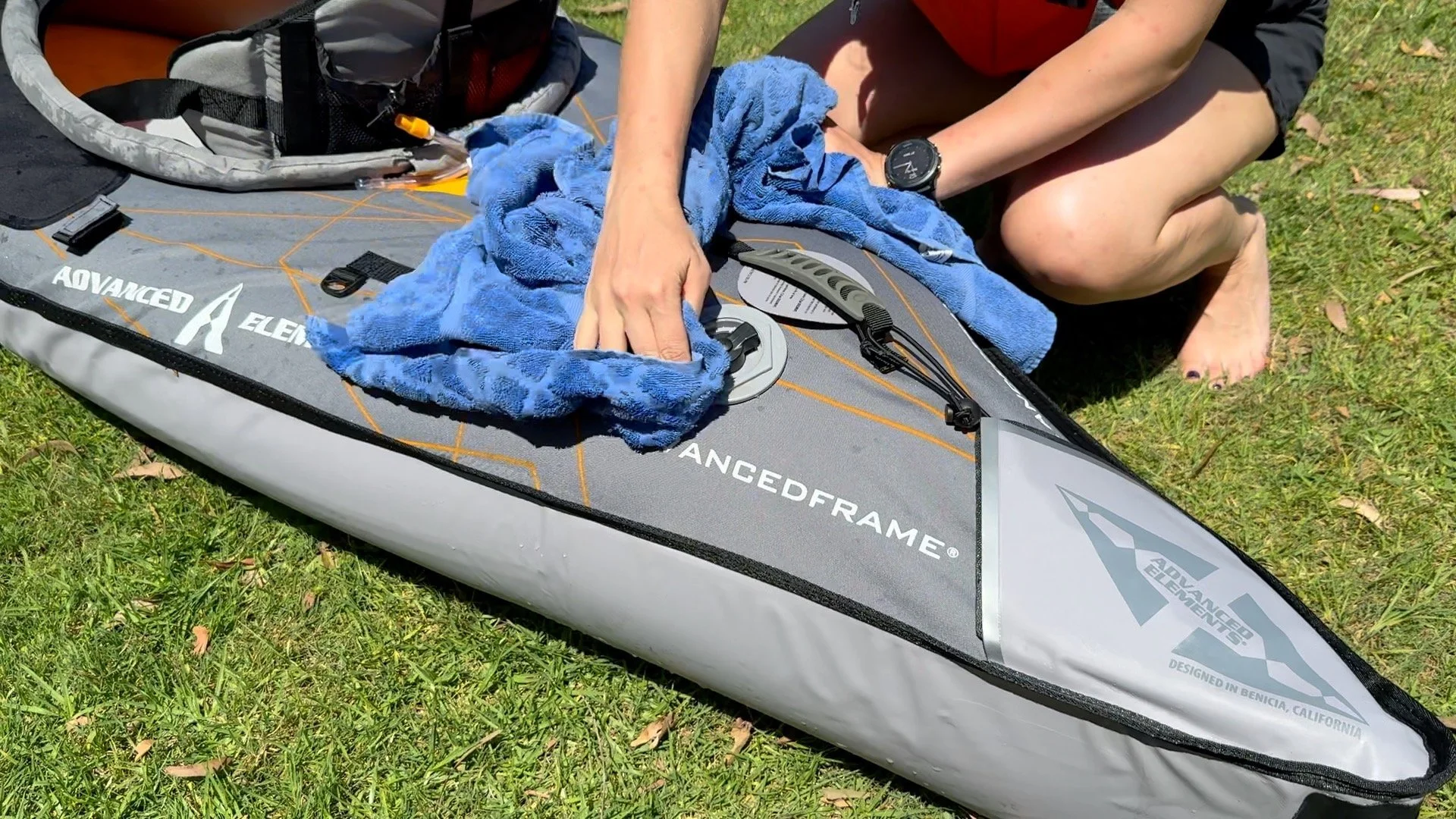
After every trip, rinse the kayak thoroughly with fresh water. This is especially important after saltwater paddling, but worth doing after any outing to wash away grit, sand, and debris. A lot of paddlers keep a jug of fresh water and a towel in the car specifically for a quick post-paddle wipe-down before packing up.
The kayak needs to be completely dry, inside and out, before it goes into storage. Packing it away damp is one of the fastest ways to end up with mold and mildew eating into the material. Hang it up in a garage, drape it over a fence, or lay it out somewhere with good airflow until it's fully dry. Don't rush this step, especially with fabric-covered hulls that hold moisture longer than bare PVC.
If your storage space gets a lot of direct sun, or if you leave the kayak outside for extended periods, a UV-protective cover or spray can help slow down material degradation. Check with the manufacturer before applying any product to make sure it's compatible with your kayak's material.
For long-term storage, particularly over winter, deflate the kayak partially rather than fully and roll it loosely instead of folding it flat. This takes stress off the seams and prevents sharp creases from forming in the material over months of storage.
Every so often, check and snug up the valves. A very slow leak is often nothing more than a valve that's worked itself slightly loose over time, not an actual puncture. Most repair kits include a valve wrench for exactly this purpose.
The single biggest advantage an inflatable has over a hard-shell is how it handles the logistics before and after paddling. An inflatable packs down small enough to fit in the trunk of a compact car, a closet, or a backpack. A hard-shell needs roof racks, a large vehicle, and dedicated storage space at home. For a lot of paddlers, especially those in apartments, smaller homes, or without a truck or SUV, that difference is a dealbreaker in favor of the inflatable.
That packability does come with some tradeoffs on the water. How noticeable those tradeoffs are depends heavily on the hull design, materials, and build quality of the specific kayak. We've laid out the main differences in the comparison table below.
| Lower-quality inflatable (vinyl, no hard structured elements) | Higher-quality inflatable (drop-stitch, stiff bow and stern) | Hard-shell recreational kayak | |
|---|---|---|---|
| Speed | Poor | Good | Excellent |
| Tracking | Fair | Good | Good |
| Stability | Fair | Good | Good |
| Comfort | Poor | Good | Good |
| Portability | Good | Good | Poor |
| Pros | Lower cost, usually lightweight | Very portable, great to paddle | Excellent paddling performance, no setup required |
| Cons | Less efficient to paddle, less durable | Requires inflation time/setup | Difficult to transport, takes up more storage space |
| Best for | Entry-level or occasional paddlers | Paddlers who want both good paddling performance and easy transport/storage | Paddlers who will always be using their kayak in the same place, ideally close to where they store it |
IInflatable kayak pricing varies depending on whether you're shopping for a solo boat or a tandem, and there's a wide range out there from entry-level to expedition-grade. Here's a rough breakdown of what to expect at each price point in the US market:
Budget: Under $700 (solo)/Under $1,000 (tandem)
What you'll typically find: Kayaks built from vinyl or fabric-covered vinyl, usually with an i-beam floor or a basic drop-stitch floor paired with inflatable side tubes.
What that means in practice: These work fine for casual flatwater paddling, family outings, or occasional use. The materials and construction are simpler, which shows up in durability and paddling efficiency over time. Great for getting started, but you may find yourself wanting more if you paddle regularly.
Mid-Range: $700 to $1,200 (solo)/$1,000 to $1,600 (tandem)
What you'll typically find: A solid mix of designs, including drop-stitch floors with side tubes and fabric-covered hulls with added stiffening. Full drop-stitch hulls are less common at this price point, so you may need to stretch the budget to find one.
What that means in practice: These are capable all-rounders that handle lakes, rivers, and mild coastal water without issue. Paddling efficiency and speed are better than budget models, though not quite at the level of premium builds.
Premium: Over $1,200 (solo)/Over $1,600 (tandem)
What you'll typically find: Full drop-stitch hulls with reinforced PVC, marine-grade hardware, and thoughtful design details throughout. Some high-end fabric-covered kayaks with drop-stitch floors and internal stiffening also sit in this range.
What that means in practice: These are the closest inflatables get to a hard-shell experience on the water. They're built for regular, demanding use across a wide range of conditions, and they show it in how they feel and handle. If you're paddling often and want something that will hold up for years, this is where to look.
Prices reflect typical online and specialty outdoor retailers carrying established brands available in the US market.
Brands Available in the U.S
There's no shortage of inflatable kayak brands available to U.S buyers, whether you're shopping through major outdoor retailers, specialty paddling shops, or online. Here's a rundown of the most commonly available brands, grouped roughly by price and build quality. Most carry models across multiple price points, so treat these groupings as a general guide rather than a hard rule.
Budget/Entry-Level
Costway: Affordable entry-level kayaks, some featuring drop-stitch floors for added rigidity
Intex: One of the most widely available budget brands, found in big-box stores and online. Good for casual, occasional use
Itiwit: Decathlon's in-house brand, offering fabric-covered kayaks and some drop-stitch options at competitive prices
Mid-Range
Aqua Marina: A popular range covering fabric-covered and drop-stitch designs across recreational, touring, and fishing styles
Gumotex: A well-regarded Czech brand with tough, fabric-covered PVC construction and a loyal following among river paddlers
Kokopelli: Known for lightweight, packraft-influenced kayaks like the Moki, popular with backpackers and travelers
Premium
Advanced Elements: A US brand known for hybrid frame inflatables that combine inflatable sections with internal aluminum ribs for added structure and performance
Grabner: An Austrian manufacturer producing high-end fabric-covered kayaks built for serious durability and long-term use
Itiwit (higher-end models): Decathlon's premium drop-stitch touring kayaks offer surprisingly strong value at the upper end of the range
Sea Eagle: A well-established US brand with a broad lineup including full drop-stitch and touring models
Razor Kayaks: An Australian brand that manufactures their own full drop-stitch and drop-stitch with side tube kayaks, with growing availability in the US market
Red Paddle Co: Primarily known for premium SUPs, but their drop-stitch kayak offerings are worth a look for paddlers who want top-tier build quality
Folding Kayaks
Oru: A California-based brand making clever origami-style folding kayaks that pack flat and perform well on the water
Klepper: The iconic German Faltboot manufacturer, with a long history and a dedicated following among traditional folding kayak enthusiasts
For the best after-sales support, stick with brands that have a strong U.S presence, such as Advanced Elements, Sea Eagle, Razor Kayaks and Aqua Marina. Being able to sort a warranty claim or get a replacement part quickly makes a real difference when something goes wrong mid-season.
Inflatable kayaks vary a lot more than you might expect, and after putting a wide range of models through their paces across different water types, some clear patterns emerged. For more information on specific models, visit our best inflatable kayak or best 2-person inflatable kayak lists.
Setup
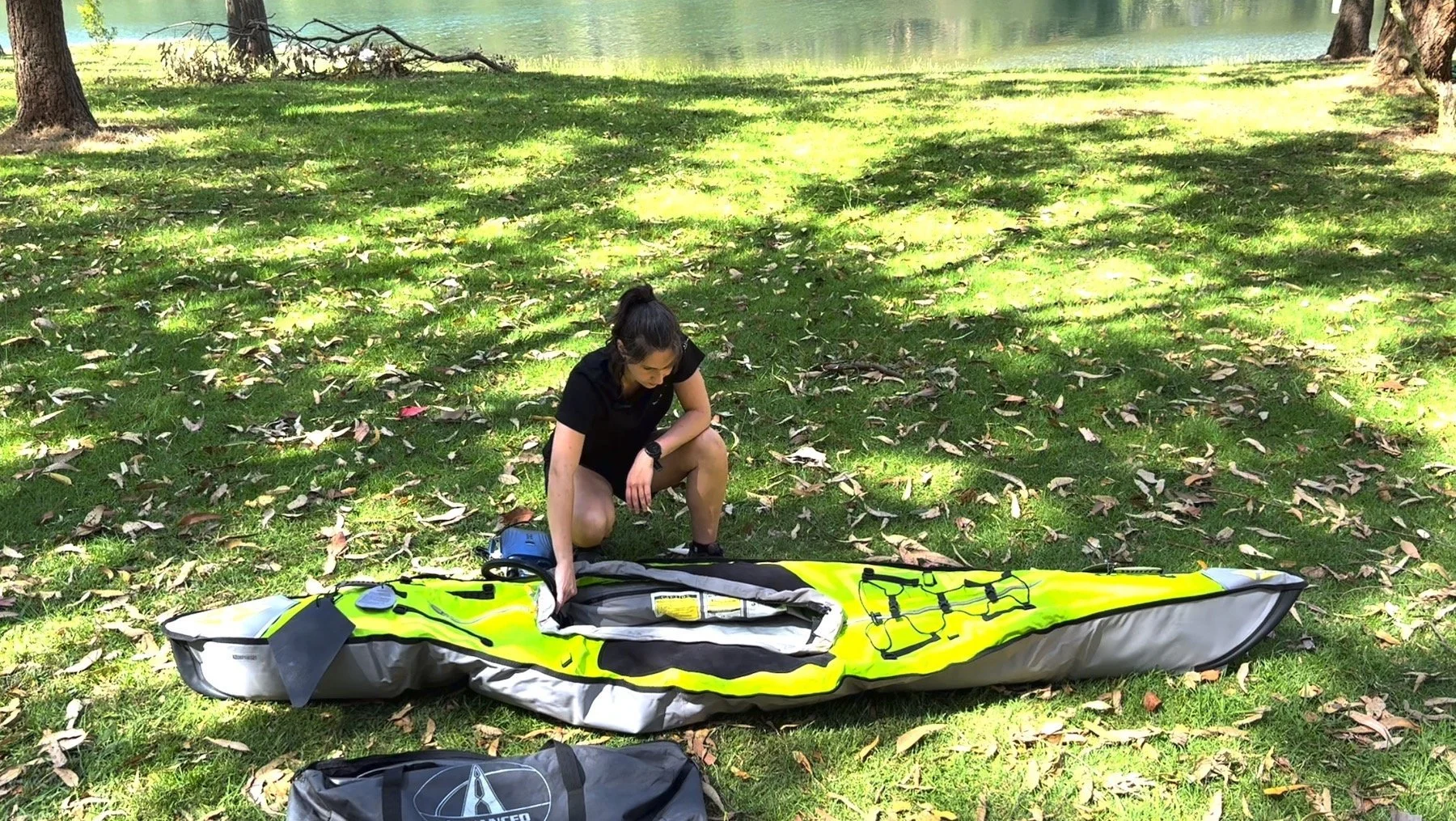
Fewer valve types means a simpler, faster inflation process. When every chamber uses the same valve, you can stay in a rhythm without stopping to swap pump attachments. A rechargeable electric pump is worth its weight here: it does the hard work for you, charges via USB-C, and fits easily inside your kayak bag so it's always ready at the water's edge.
One thing that surprised us was that for shorter carries from the parking lot to the launch spot, a fully inflated kayak is often easier to manage than a floppy, half-packed one. Rest the middle section against your shoulder or use carry handles and straps clipped to the hull. It sounds counterintuitive, but it works.
Paddling
The kayaks that performed best on the water consistently shared a few key features:
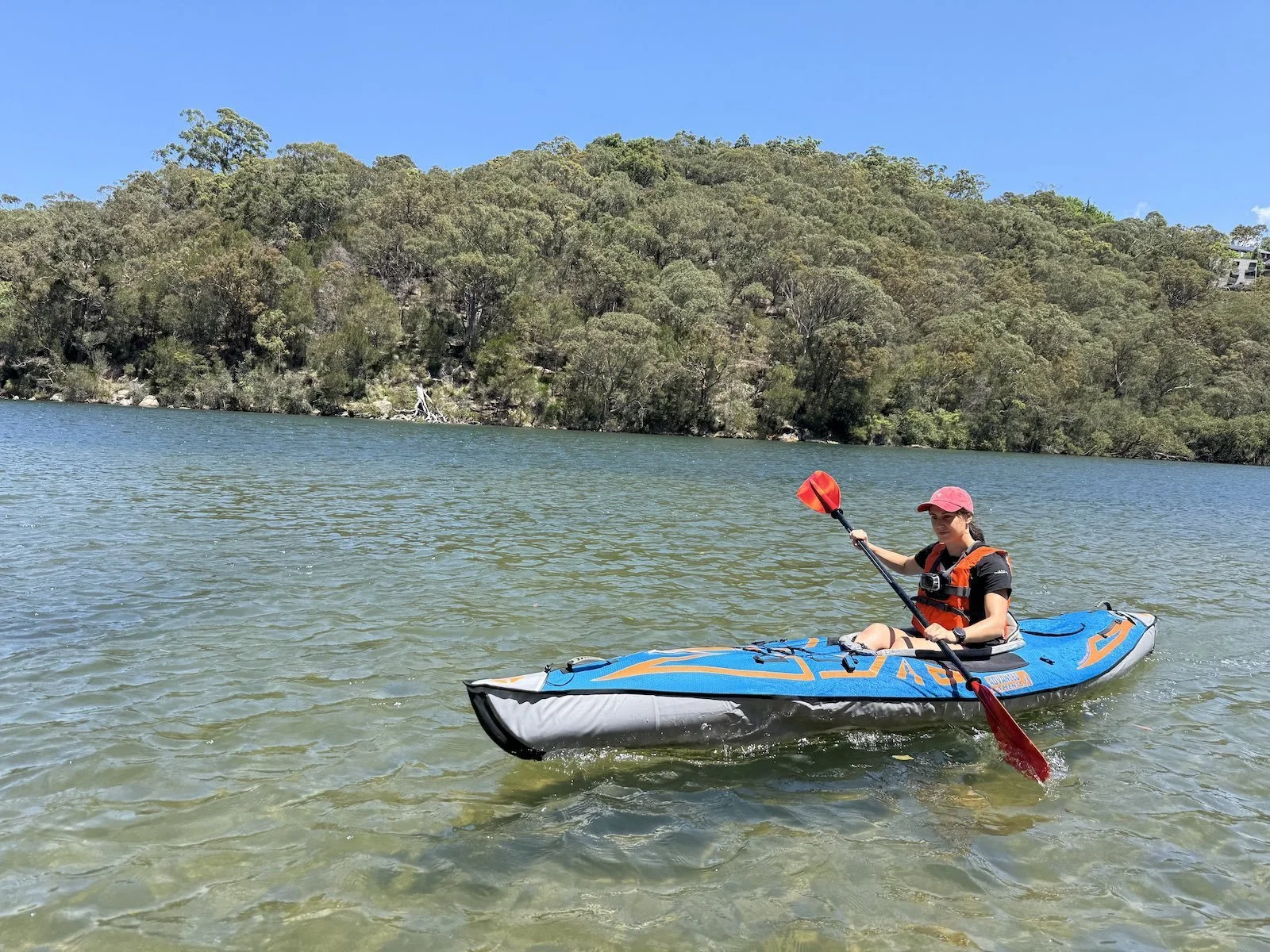
A removable skeg at least 6” long. Models with longer skegs tracked noticeably better than those with short ones, no skeg at all, or hull shapes alone trying to do that job.
At least a drop-stitch floor, and ideally a full drop-stitch hull. A soft, spongy floor absorbs paddle energy and makes the whole experience feel sluggish. Drop-stitch feels immediate and direct by comparison.
Bow and stern stiffeners, whether that's plastic nose caps, reinforced sections, or internal aluminum rods. These help the kayak hold its shape, cut through chop, and feel more composed at speed.
Packdown and Storage
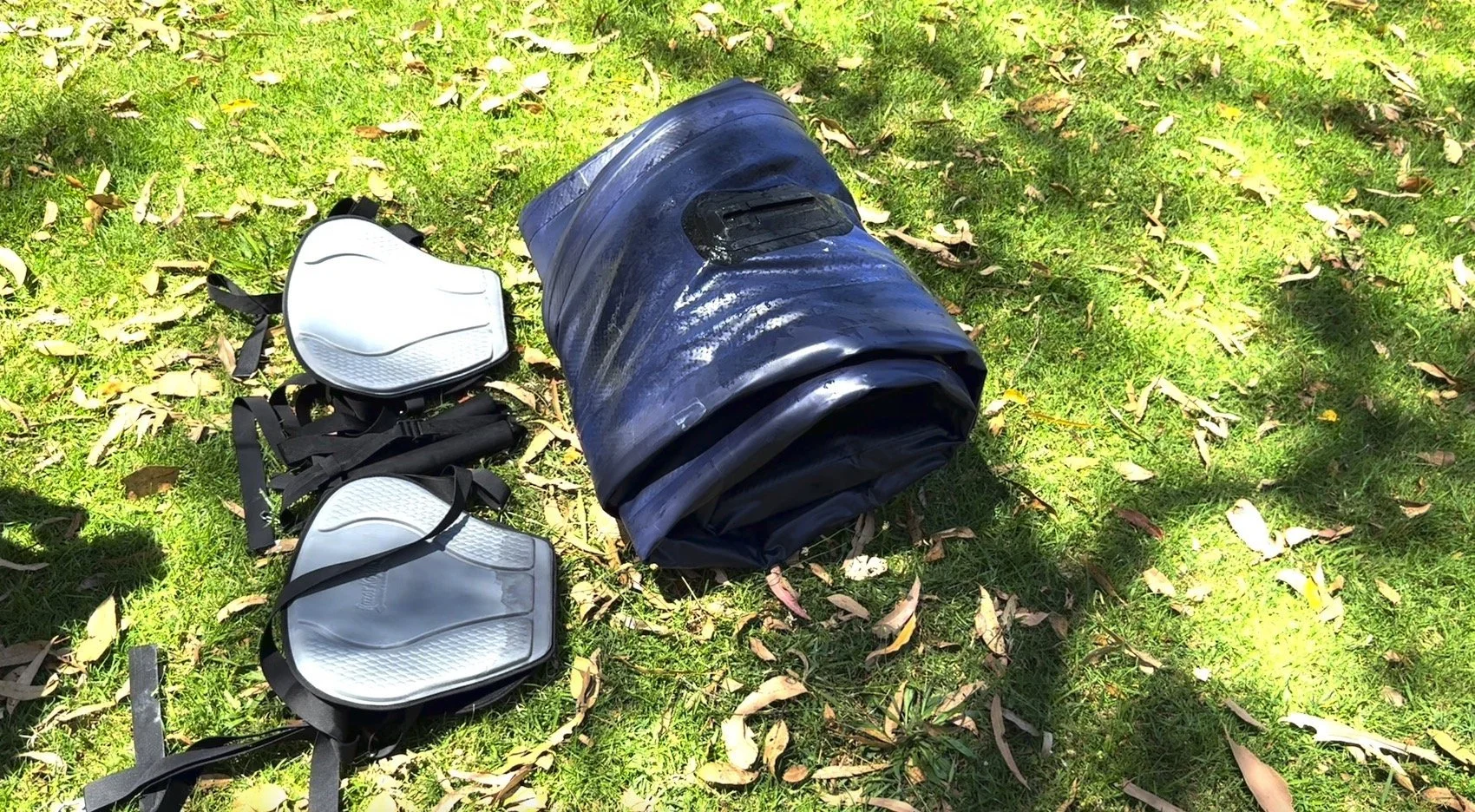
Bare PVC hulls are the clear winner here. Fabric-covered kayaks take a long time to dry fully, and despite best efforts, mold has been a recurring issue with them, even when packed away feeling dry to the touch. PVC is far more forgiving if it goes away slightly damp, which in the real world happens more often than you'd like.
Whatever material your kayak is made from, always roll it loosely for storage rather than folding it flat. On vinyl models especially, avoid creating sharp creases directly over any rigid plastic components, as the material is more likely to crack or split at those stress points over time.
For detailed test results and individual model reviews, head over to our best inflatable kayaks guide.
Are inflatable kayaks any good?
1
Yes, genuinely. Modern inflatable kayaks have come a long way from the flimsy pool toys you might be picturing. A decent one made from reinforced PVC or drop-stitch material can hold its own against many hard-shell kayaks on lakes, rivers, and even coastal water. The main thing that makes them great isn't just performance though, it's the convenience. They pack down small, store easily, and mean you don't need a truck or roof rack to get to the water.
12
What are the disadvantages of an inflatable kayak?
2
A few things are worth knowing going in. They take time to set up and pack down, usually 6 to 20 minutes each way once you're practiced. They're generally a bit slower and less efficient to paddle than a comparable hard-shell. Fabric-covered models can be a pain to dry properly. And while punctures are less common than people expect, you do need to carry a repair kit. If you always paddle the same local spot and have storage for a hard-shell, that might actually suit you better.
What is the best brand of inflatable kayak?
3
It depends on your budget and how you plan to paddle. Sea Eagle and Advanced Elements are well-regarded US brands with solid reputations for quality and customer support. Aqua Marina offers good value across a range of price points. For premium performance, brands like Grabner and Gumotex are worth looking at, though they sit at the higher end of the market. Decathlon's Itiwit range punches above its weight for the price, especially for beginners.
What is the lifespan of an inflatable kayak?
4
A well-made inflatable kayak, properly looked after, can last anywhere from 5 to 15 years or more. Budget vinyl kayaks will tend toward the shorter end of that range, while high-grade reinforced PVC or TPU models can last well over a decade with regular use. The biggest factors are how well you clean and dry it after each trip, how carefully you store it, and whether you keep it out of prolonged UV exposure when not in use.
What is the 120 rule in kayaking?
5
The 120 rule is a simple cold water safety guideline. Add the air temperature and the water temperature together in Fahrenheit, and if that number is below 120, you should be wearing a wetsuit or drysuit. Cold water is dangerous fast: even strong swimmers can lose muscle control within minutes of unexpected immersion in cold water. The rule is a useful reminder that the air temperature alone doesn't tell you the full story about how safe conditions really are.
How long can you leave an inflatable kayak inflated?
6
Are inflatable kayaks easy to flip?
There's no hard rule here, but most manufacturers are fine with leaving a kayak inflated for days or even weeks at a time, as long as it's stored out of direct sunlight and away from extreme heat. Heat causes air to expand, which can put stress on seams and valves, so don't leave it sitting in a hot car or baking in the sun when you're not using it. If you're storing it for longer than a few weeks, it's better to deflate it partially and roll it loosely.
Generally, no. Most inflatable kayaks are wider than hard-shell kayaks, and the big inflated side tubes add a lot of stability. For most recreational paddlers on calm water, tipping one over actually takes some effort. That said, narrower touring or performance models are a bit more tippy, and any kayak can capsize in rough water or strong wind if you're caught off guard. Wearing your PFD is still essential regardless of how stable your kayak feels.
Are inflatable kayaks easy to puncture?
7
Less than you'd think. A quality inflatable made from reinforced PVC is genuinely tough and can shrug off contact with rocks, gravel, and debris that would scratch up a hard-shell. Basic vinyl kayaks are more vulnerable, especially to sharp objects. The good news is that even if you do get a puncture, most inflatables have multiple air chambers, so one hole won't sink you. And patching a small puncture is straightforward with a basic repair kit.
Do people fish in inflatable kayaks?
8
Absolutely, and it's become pretty popular. Inflatable fishing kayaks are a proper product category at this point, with wide, stable platforms, rod holder attachments, gear mounts, and raised seating positions designed specifically for fishing. They're great for reaching spots that are hard to get to by boat or on foot, and they're easy to transport to remote lakes and rivers. Just make sure you're looking at a model with a drop-stitch floor for solid stability when you're casting or reeling in.
Do you need a life jacket on an inflatable kayak?
9
Yes. Under US Coast Guard rules, every vessel including kayaks must have a Coast Guard-approved PFD on board for each person. Many states also require it to be worn, not just carried, particularly for children. Beyond the legal requirement, it's just smart: even calm water can turn dangerous quickly, and a PFD could save your life if you capsize unexpectedly. Get one designed specifically for paddling so it doesn't restrict your arm movement.
What is better, a foldable kayak or an inflatable kayak?
10
They both have their strengths. Foldable kayaks perform more like a hard-shell on the water and are great for paddlers who want that feel without needing roof racks. The tradeoffs are that they're heavier, more complex to assemble, and generally more expensive. Inflatable kayaks are easier to set up, pack down smaller and lighter, and are more affordable across the range. For most people, especially those newer to kayaking or focused on convenience, an inflatable is the more practical choice.
How to pick an inflatable kayak?
11
Start with where you'll be paddling most: flatwater lakes and slow rivers, coastal water, whitewater, or long-distance touring. Match the hull shape and design to that use. Then think about your budget, how often you'll be out, and whether you'll be paddling solo or with someone else. Look for drop-stitch construction if performance matters to you, a removable skeg for better tracking, and reinforced PVC if durability is a priority. Don't forget to factor in weight and packed size if you'll be carrying it any distance.
How much is a good inflatable kayak?
13
You can get a decent entry-level solo kayak for around $300 to $600, which is fine for occasional casual use. Mid-range models between $700 and $1,200 offer noticeably better performance and durability for regular paddlers. Premium kayaks above $1,200 are built for serious, frequent use and get closest to hard-shell performance. For a tandem kayak, expect to add roughly $300 to $500 at each tier. Spending a bit more upfront usually pays off if you're going to paddle more than a handful of times a year.
Do inflatable kayaks have foot rests?
14
Most do, yes. Foot rests are important for paddling efficiency and comfort, and the majority of inflatable kayaks either include them or have a way to add them. Some are simple foam pads with Velcro strips, others are adjustable plastic or metal frames that clip into the hull. When trying a kayak or reading reviews, it's worth checking whether the foot rest setup works for your height, since a poor fit can make longer paddles uncomfortable pretty quickly.
Wrapping It Up
Inflatable kayaks have come a long way from their pool toy reputation. The best modern designs can handle conditions that once belonged exclusively to hard-shells, while still folding down small enough to fit in a closet, a car trunk, or a checked bag on a flight to your next paddling destination.
The standout models share a few things in common: drop-stitch construction, tough reinforced PVC, and bow and stern stiffeners that help the hull hold its shape under load and in chop. A removable skeg makes a real difference to straight-line running, and hull shape should match how you actually paddle. Curved drop-stitch works well for most all-around use, bathtub or V-shaped designs suit distance paddlers, and a drop-stitch floor with side tubes is a great starting point for beginners or anyone building a stable fishing platform.
For U.S paddlers, inflatables open up a huge range of possibilities. Whether you're hauling one into a backcountry lake in the Cascades, storing it in a New York City apartment, or tossing it in the back of a van for a road trip down the coast, the portability factor is genuinely hard to beat. They make a lot of sense for anyone without dedicated storage space, anyone who likes to explore different waterways rather than sticking to one local spot, or anyone who just doesn't want to deal with a roof rack every time they want to get on the water. If you always paddle the same stretch near home and have a garage to store a hard-shell, that might still be the better call, but for most people, a quality inflatable covers a lot of ground.
For hands-on reviews and in-depth testing of specific models available in the U.S, check out our best inflatable kayaks and best 2-person inflatable kayaks pages.